You stand in front of the mirror, the foundation that worked at 38 now settles into your smile lines, eyeliner that used to look sharp now smudges before noon. Sound familiar? You’re not alone; millions of women notice this shift in their 50s, and almost none of them were ever taught.
Here’s the truth: knowing how to apply makeup over 50 isn’t about covering up, it’s about working with the skin you have right now, skin that carries wisdom, warmth, and a whole lot of lived experience.
Your skin has changed. It’s producing less oil, losing a little elasticity, and exhibiting more texture, which doesn’t mean makeup won’t work; it means your approach needs a thoughtful upgrade.
In this guide, you’ll find practical, step-by-step techniques backed by makeup artists and dermatologists, delivered in plain language, without fluff. From skin prep to lip color, every section is designed to help you feel confident, radiant, and completely yourself. Let’s get into it.
Why makeup feels different after 50
Before you change your technique, it helps to understand why your skin behaves differently now. After menopause, estrogen levels play a significant role in maintaining skin’s plumpness, hydration, and resilience. The result? becomes thinner, drier, and more prone to fine lines and texture.
Many women also notice that pores look larger (they haven’t actually grown, they’re just less “cushioned” by surrounding collagen). That foundation seems to sink into expression lines rather than sit smoothly on top. This is completely normal; it’s not a flaw in your skin. It’s a change in its structure.
The good news? Once you understand what’s happening, you can choose products and techniques that genuinely flatter mature skin. The goal isn’t to look younger. It’s to look like you: glowing, polished, and as vibrant as you feel on your best days.
This shift is also a beautiful invitation to simplify. Many women over 50 find that less makeup, applied thoughtfully, looks far more luminous than a heavy full-coverage routine, layers, more glow, more you. If you want to build the strongest possible canvas before you even open your makeup bag, start with the right anti-aging skincare products that truly support mature skin, because great makeup always starts with great skin.
How to Apply Makeup Over 50: Skin prep
Ask any professional makeup artist what the single most important step is for mature skin, and the answer is almost always the same: preparation. You can have the best foundation in the world, but if your skin is dry and unprimed, it will still look patchy and textured.
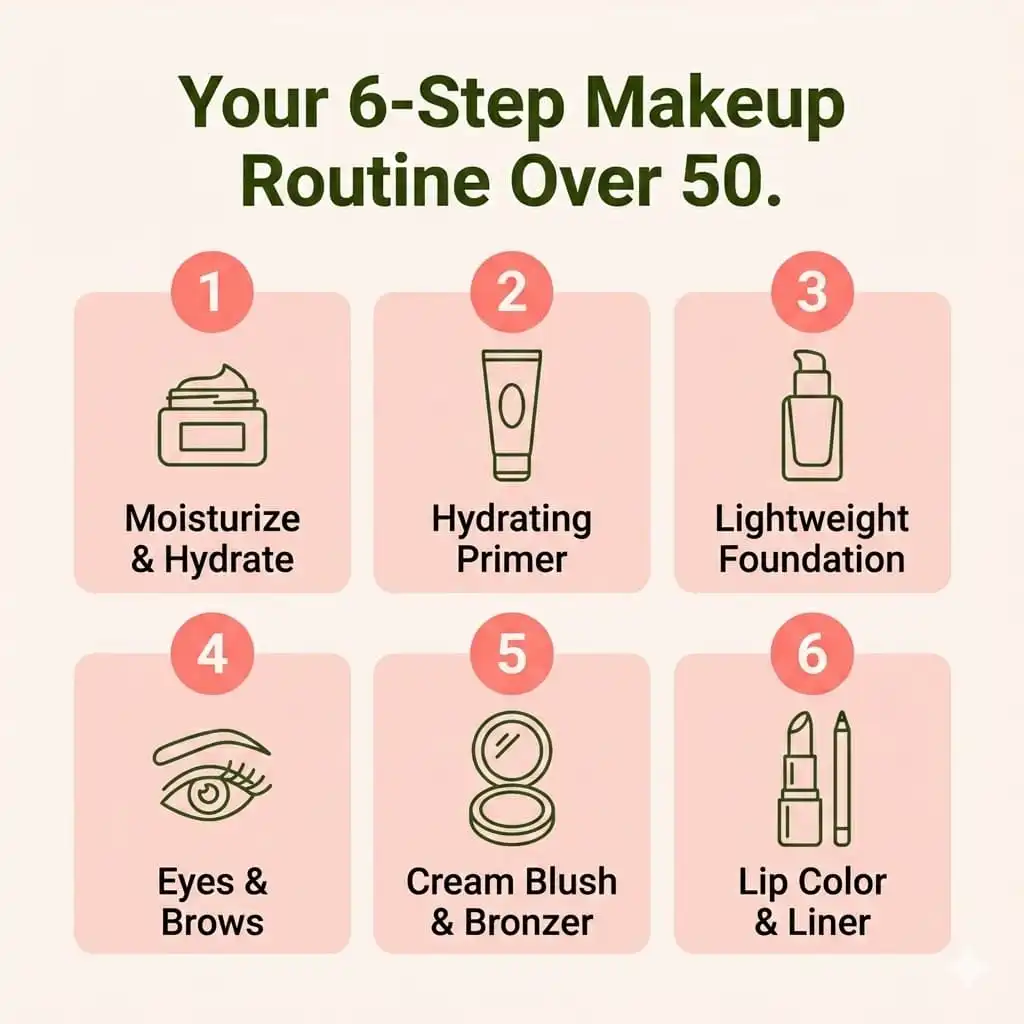
Start with a generous application of moisturizer, ideally one with hyaluronic acid or peptides, which help plump fine lines from within. It takes two to three minutes to absorb before any makeup. This isn’t extra time. It’s an investment.
Next, consider a hydrating primer (not a mattifying one; avoid those for mature skin). A good primer fills fine lines temporarily, creates a smooth canvas, and helps your foundation grip evenly. Apply it with your fingertips using gentle pressing motions rather than rubbing.
On special days, celebrity makeup artist Lisa Aharon recommends applying a hydrating sheet mask or serum before foundation to “deliver product more deeply” and “ensure a healthy glow.” Even five minutes with a serum under occlusion can make a remarkable difference in how luminous your skin looks.
Eye cream is non-negotiable. The skin around your eyes is the thinnest on your face, and applying concealer to dry, unprepared under-eye skin leads to creasing within an hour. Tap, never rub, a small amount of eye cream around the orbital bone and let it set before concealer. For a complete daily framework that sets all of this in motion, a well-structured morning skincare routine for women over 50 will make every makeup step easier, faster, and more effective.
How to apply makeup over 50: foundation on mature skin
This is where most women over 50 need the biggest shift, and once you make it, everything else falls into place. The rule is simple: go lighter than you think you need to.
“The more mature you are, the less heavy your foundation should be,” says Rose-Marie Swift, celebrity makeup artist and founder of RMS Beauty. “Thick makeup applied onto mature skin only exaggerates the quality of the skin. The thinner the base and the more moisturizing it is, the better it will look.” For related Lonage guidance, see makeup & beauty after 50.
For most women over 50, a tinted moisturizer or lightweight liquid foundation with medium, buildable coverage is ideal with hydrating ingredients such as hyaluronic acid, glycerin, or peptides. Avoid powder foundations entirely, as they dry texture and settle into lines.
How you apply it matters just as much as what you use. A damp beauty sponge (not dry) is ideal. Pressing product into the skin rather than dragging it across the surface. Start at the center of your face and blend outward in gentle dabbing motions. You’re pressing, not painting.
Apply in thin layers. If you need more coverage in one spot, add just there, not another full layer everywhere. This prevents the dreaded “cakey” finish that settles into smile lines.
Finish with a setting spray, not powder. Setting sprays lock in moisture and maintain a dewy, skin-like finish. Powder can still be used minimally on the T-zone if needed, but use a fluffy brush, a translucent formula, and the absolute lightest hand.
For concealer, choose a formula that is creamy and won’t dry down too much. Apply with your ring finger, the lightest finger on your hand, using a gentle tapping motion. Less is genuinely more under the eyes.
Eyes over 50: liner, lashes, and brows
Your eyes are one of the most expressive parts of your face, and with a few smart adjustments, they can look absolutely stunning. The key is opening up the eye, not closing it down with heavy liner or dark shadow that makes the lids look smaller.
When it comes to eyeliner, a soft pencil or smudge-tip liner is your best friend. Liquid liner can look harsh on mature eyes, especially if your lids have become a little hooded. A pencil gives you a softer, more blended line that defines without constricting. Apply along the upper lash line only, and use a small brush or your fingertip.
Skip the lower waterline liner, as its eyes look smaller and exaggerate undereye shadows. Instead, apply a soft nude or white pencil to the waterline to instantly brighten and open your eyes.
For eyeshadow, choose matte neutral shades in the crease to add depth without shimmer that catches in fine lines. A soft champagne or satin (not glittery) highlight on the inner corner and brow bone adds brightness and lift. Avoid dark, heavy shadow on the entire lid.
Mascara is essential. Focus it on the upper lashes. Curl your lashes first with a heated or regular curler, as this opens the eye dramatically. For lower lashes, use just a light coat or skip mascara entirely to avoid the “tired” look.
Your brows are arguably the most important feature to maintain. Brows naturally thin after 50, and well-defined brows provide structure to the face. Use a fine brow pencil or powder in a shade slightly lighter than your natural hair color. Fill in sparse areas with light, hair-like strokes, never a solid drawn line.
Blush, bronzer, and a naturally lifted look
This is the section most women skip, and it’s a mistake. Color is the fastest way to look refreshed and alive. A face without blush after 50 can look flat; a face with well-placed blush looks luminous and lifted in seconds. Cream blush over powder for mature skin. Cream formulas melt into the skin, add a natural, hydrated flush, and won’t cling to dry patches the way powder can. Apply with your fingertips or a soft brush to the apples of your cheeks, the round part that rises when you smile, and blend upward toward your temples.
Avoid placing blush too low on the cheek. Placement that drifts downward can catch the eye and add visual heaviness, a lifting effect, slightly upward.
For bronzer, think sun, not shadow. Apply it horizontally across the forehead, cheekbones, and bridge of the nose, the places where the sun naturally warms the skin. Avoid contouring with bronzer, as it can be harsh on mature skin and add shadows where you don’t need them.
A touch of highlighter on the very tops of your cheekbones, the bridge of the nose, and the Cupid’s bow adds a lit-from-within glow. Choose a finely milled, subtle highlight or a chunky one that can blend into the texture. Satin finishes are your friend. And remember: this kind of outer radiance is deeply connected to how you care for yourself from the inside out. Discover how everyday habits build confidence and vitality after 50 in ways no highlight brush ever could.
Lip color that lasts and looks beautiful
Here’s a question many women ask quietly: Can I still wear bold lip color after 50? The answer is an emphatic yes, with one smart technique that makes all the difference.
As we age, lips lose a little volume and definition, and the skin around the mouth develops fine vertical lines. This means that lip products, especially creamy or glossy formulas, can feather and bleed. The solution is a lip liner. It’s the single most underused tool in the over-50 beauty kit.
Choose a lip liner that matches your lip color (or is close to your lipstick shade). Line slightly outside your natural lip line, or right on the precision line. Fill in your entire lip with liner as a base, as this extends the wear of any lipstick you apply on top.
For lipstick formula, choose satin or cream finishes over matte. Matte lipsticks are extremely drying and cause fine lines on and around the lips. Satin formulas deliver color with a slight sheen that actually makes lips look plumper and more hydrated.
Don’t shy away from color. Berries, roses, corals, and even a classic red are all stunning on women over 50. The key is keeping the rest of your makeup balanced: a bold lip pairs beautifully with softer eye makeup. And a nude lip lets dramatic eye looks take center stage.
Blot, don’t rub. After applying lipstick, press a single tissue between your lips once to remove excess product. This helps the color last longer without looking heavy. Reapply over your liner base for a freshened look that stays put.
Frequently asked questions:
How to put on makeup over 50 for beginners?
Start simple: a hydrating moisturizer, a lightweight tinted moisturizer or BB cream, cream blush, one coat of mascara, and a tinted lip balm. That’s a complete, polished look. As you get comfortable, layer in a brow pencil and a soft eyeliner. The goal isn’t a full face. It’s feeling like the best version of yourself. Less product, thoughtfully applied, almost always looks more natural and radiant on mature skin.
What is the best way to apply foundation on mature skin?
Always start with a hydrated, primed face. Choose a lightweight liquid or serum foundation, powder. Apply with a damp beauty sponge, pressing product into the skin in a stippling motion rather than swiping. Build coverage in thin layers only where. Finish with a hydrating setting spray instead of powder to maintain a dewy, skin-like finish that doesn’t settle into fine lines or expression lines.
Should you wear eyeliner in your 50s?
Absolutely, but technique matters. A soft pencil liner along the upper lash line defines the eyes beautifully. Avoid heavy liquid liner and harsh lines on the lower waterline. A nude or white pencil on the lower waterline is a game-changer. It opens eyes and makes them look brighter and more awake instantly. Keep liner soft, not dramatic,effect.
What makeup is best for mature skin over 50?
Look for hydrating, lightweight formulas across the board. Cream blush, serum foundations, satin lipsticks, and hydrating setting sprays all work beautifully with the changing texture of mature skin. Ingredients like hyaluronic acid, peptides, and glycerin in your makeup products provide extra skin benefits. Avoid heavy powders, matte finishes on lips, and thick concealers.
Makeup is an act of Self-Expression at every age
Learning how to apply makeup over 50 is one of the most empowering investments you can make in how you show up every day. It’s not vanity. It’s self-care, a five-minute ritual that signals to your brain and body: I value myself, I’m showing up fully today.
Start with just one new technique from this guide this week. Maybe it’s switching to a damp sponge for foundation. It’s a cream blush. Small shifts create real results. And remember: if anything feels unusual on your skin or you’re navigating significant skin changes, a consultation with your dermatologist is always a wise step. What small step will you try this week?
For broader guidance on this topic, explore our skin, beauty and hair after 50 hub.
For the main guide, see anti-aging skin after 50.