

You catch your reflection in the car mirror, or worse, on a video call, and there they are: horizontal lines across your neck that seem to have appeared overnight. Neck wrinkles at 50 catch so many women off guard, even those who’ve been diligent about their skincare for years.
Here’s what usually happened: the daily moisturizer, the SPF, the careful routine, it all stopped right at the jawline. The neck got skipped, again and again, for decades.
You’re not alone in this, and this doesn’t mean you’ve done anything wrong. This article walks through why neck wrinkles at 50 show up the way they do, and what actually helps, without vague promises or shame.
Why neck wrinkles at 50 become more noticeable
The skin on your neck is thinner than the skin on your face, and it has far fewer oil glands. That means it dries out faster and shows texture sooner, especially once you hit your 50s.
Sun exposure adds up here, too. Think about every drive with sunlight streaming through the driver’s side window, hitting your neck for years without a second thought. Most of us never think to apply SPF below the chin.
Menopause plays a small supporting role as well, since lower estrogen can leave skin drier and less resilient overall. But the bigger, more fixable issue for most women is simply this: skincare routines quietly stop at the jawline, leaving the neck unprotected and under-moisturized for years.
If you’re still building the basics, our skin care routine for women over 50 gives you a simple daily framework to follow, one that naturally extends down to the neck, too.
Many women notice this shift and feel caught off guard, especially when the lines seem to appear seemingly out of nowhere. The truth is, they’ve likely been developing gradually for years, just unnoticed until now.
Horizontal neck lines vs. crepey neck skin
These two things get lumped together, but they’re not quite the same. Horizontal neck lines, sometimes called “necklace lines,” are distinct creases that run across the neck, often visible even when your skin is relaxed.
Crepey neck skin, on the other hand, refers to a finer, thinner, slightly crinkled texture, more like tissue paper than defined lines. You can absolutely have both at once, and many women in their 50s do.
Posture plays a bigger role than most people realize. Looking down at your phone for hours, hunching over a laptop, or sleeping on your side night after night all encourage repeated creasing in the same spots. Over time, that repeated folding can deepen lines that started out faint.
Dryness makes both issues more visible too, since well-hydrated skin simply reflects light differently and looks smoother. That’s why hydration matters just as much as any single ingredient, especially once estrogen levels shift and skin naturally holds onto less moisture.
Whichever combination you’re noticing in the mirror, know that this is an incredibly common pattern, not a sign that your skin has failed you.
Daily neck care habits that actually help
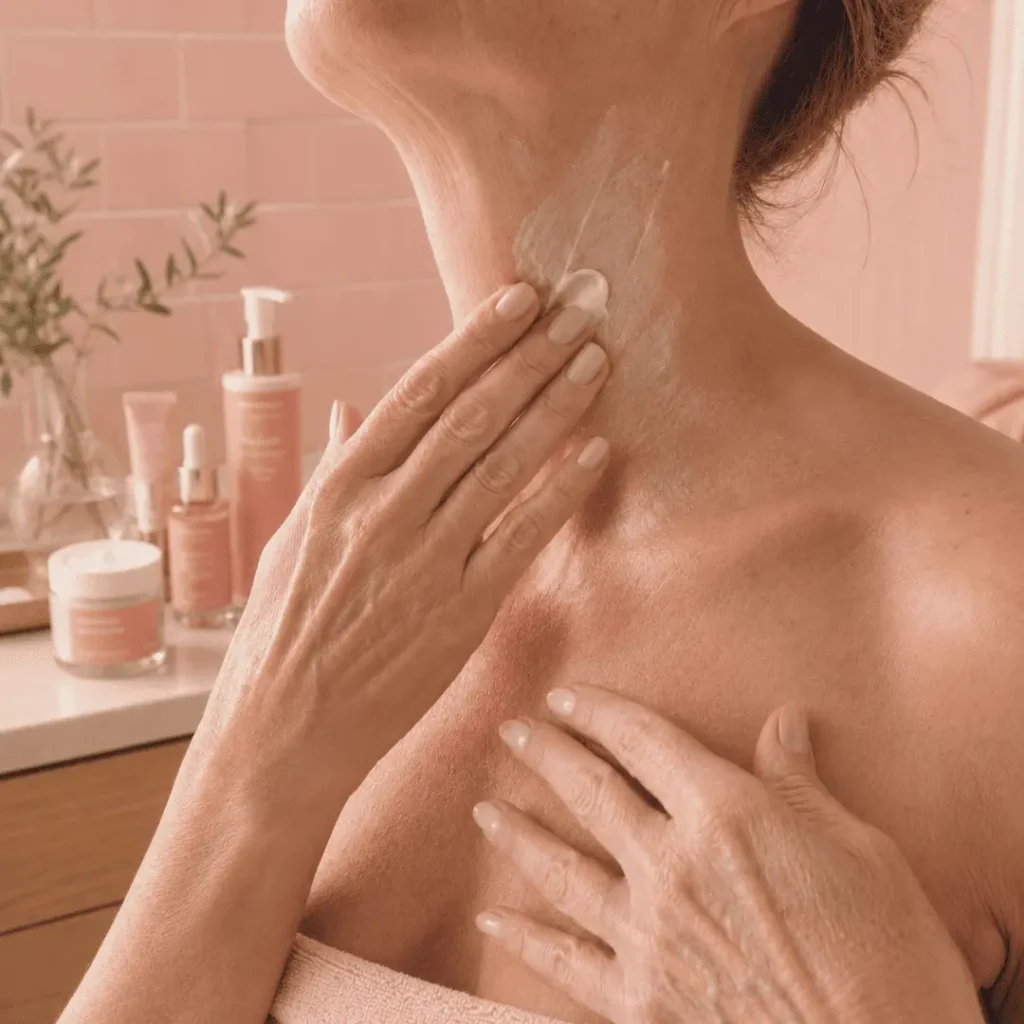
The good news is that neck care doesn’t require anything complicated. It just requires consistency, and a willingness to treat your neck the way you already treat your face.
Start by extending your cleanser down to your neck and collarbone every time you wash your face. Follow with a gentle, fragrance-free moisturizer applied in soft upward strokes, since the neck’s delicate skin doesn’t need aggressive rubbing.
Apply broad-spectrum SPF 30 or higher to your neck every single morning, rain or shine, cloudy or clear. This one habit alone, done consistently, makes a meaningful difference over months and years.
At night, a richer cream can help replenish moisture lost during the day. One of our readers, a retired teacher from Ohio, started simply carrying her facial moisturizer down to her collarbone each evening. Within a couple of months, she noticed her neck felt softer and looked less dry.
If your neck also feels tight, rough, or easily irritated, a little extra moisture and patience usually help it settle down over time. Small, consistent habits like this compound over time, and that’s genuinely the whole strategy.
Best ingredients for neck skin after 50
Not every ingredient in your skincare cabinet is neck-friendly, since this skin is more delicate and reacts more easily to strong actives. Knowing what actually helps saves you time, money, and irritation.
Broad-spectrum SPF 30+ remains the single most important daily step, full stop. Beyond that, ceramides help rebuild your skin’s natural moisture barrier, which is especially useful given how easily neck skin dries out.
Peptides and hyaluronic acid support hydration and the skin’s underlying support structure, often called collagen, which keeps skin feeling firmer. Niacinamide is another gentle option that supports overall skin tone and texture without much risk of irritation.
Gentle retinol or retinal can help with skin renewal over time, but the neck is more sensitive than the face, so start slowly, perhaps just once or twice a week, and always follow with moisturizer. For a fuller breakdown of ingredients like peptides, niacinamide, retinol, and ceramides, our guide to skincare products that support mature skin can help you shop with more clarity.
You don’t need ten products. A handful of well-chosen, gentle ingredients used consistently will outperform an overwhelming routine every time.
Posture, sleep, and sun habits that affect your neck

Sometimes the most impactful changes have nothing to do with products at all. Think about how many hours a day you spend looking down at your phone, your laptop, aor book.
This repeated downward angle, often called “tech neck,” encourages the same creases to form again and again. Try raising your phone closer to eye level, and propping your laptop up a few inches, small adjustments that add up over a day, a month, a year.
Side-sleeping can press the same fold into your neck night after night. If you tend to wake up with a crease that takes a while to smooth out, sleeping more on your back, even part of the night, may help reduce that repeated pressure.
Don’t forget your commute either. Sunlight through a car window reaches your neck just as easily as your face, so keep SPF within arm’s reach, or keep a light scarf handy for long drives. Because sleep and stress also influence how skin looks and feels, our guide to stress and skin aging explains why recovery habits matter after 50.
None of these habit shifts happens overnight, and that’s okay. This is about steady, sustainable care, not a dramatic overnight fix.
When to ask a dermatologist about neck wrinkles
Most neck wrinkles at 50 are simply a normal, expected part of aging skin, and daily habits like SPF and moisture go a long way. But there are times when a dermatologist’s guidance is genuinely worth seeking out.
If you notice sudden changes, ongoing irritation, or a new spot that looks different or concerning, it’s always worth having a professional take a look. That’s simply good, proactive care, not an overreaction.
If you’re curious about more targeted options, dermatologists can discuss things like prescription-strength retinoids, gentle laser treatments, radiofrequency, or microneedling, each with different levels of intensity, cost, and recovery time. These are choices, not requirements, and what works well for one woman may not suit another.
If you’re curious about professional options in a broader mature-skin context, our guide to facial treatments after 50 explains what to consider before choosing treatment.
There’s no shame in seeking support, and no shame in choosing to simply keep things gentle and consistent instead. Both are valid paths forward.
Frequently asked questions:
Why is my neck so wrinkly at 50?
Neck skin is thinner and has fewer oil glands than facial skin, so it dries out and shows lines earlier. Add years of unprotected sun exposure and skincare routines that stop at the jawline, and visible wrinkles by 50 are extremely common, not a sign that anything’s wrong.
What does a 50-year-old neck look like?
Every neck looks different at 50, but common changes include horizontal lines, finer crepey texture, and slightly looser skin. These reflect natural collagen changes, sun exposure, and posture habits like looking down at phones, and they vary widely from woman to woman.
How to tighten neck skin after 50?
Daily SPF, a gentle moisturizer, and ingredients like peptides, ceramides, or gentle retinol used consistently can support firmer-feeling skin over time. For more noticeable results, a dermatologist can discuss options like retinoids or in-office treatments suited to your skin.
Is it normal to have wrinkles at 50?
Yes, completely. Wrinkles, including those on the neck, are one of the most common and expected signs of skin changing with time. Nearly every woman notices some visible shift by this age, and it’s a natural process, not a personal shortcoming.
Neck wrinkles at 50 are common, natural, and deeply human. What matters most isn’t chasing a perfect neck, but caring for this delicate skin with SPF, moisture, gentle ingredients, posture awareness, and patience.
“If you notice sudden changes, irritation, or a spot that worries you, ask a dermatologist for personalized guidance. Real change comes from small, steady habits, not overnight fixes, and your neck deserves the same patience and care you give the rest of your skin. What small neck-care habit will you try this week?”