
It was a Tuesday afternoon, and I was staring at a wall of bottles that all promised to fix me. One claimed to stop hot flashes, another promised endless energy, and a third swore it would bring back my waistline. I felt small, confused, and honestly, a little bit broken.
If you’ve had a version of that moment, you’re in exactly the right place.
What I’ve learned since that confusing afternoon is that there is no magic pill for perimenopause. Supplements can be useful when they address a genuine nutritional need or have evidence for a specific purpose, but they are not a substitute for food, movement, sleep, or appropriate medical care. For the bigger picture, start with our menopause after 50 guide.
Let me walk you through the supplements that come up most often, what the evidence can and cannot tell us, and when a deeper Lonage guide can help you make a more informed decision.
Why supplement needs can change during perimenopause and after 50
Perimenopause and menopause involve hormonal changes that can affect several aspects of health, while aging itself can also change nutritional needs, body composition, bone health, and the way some nutrients are absorbed or used. That does not mean every woman needs the same supplements.
Your diet, medications, health conditions, symptoms, and laboratory results all matter. The most useful approach is to identify a reason for taking a supplement rather than assuming that menopause automatically creates a deficiency.
The supplement foundation: start with need, not hype
Before we talk about anything trendy, I would start with the basics: what you eat, what your clinician has identified, and whether a supplement fills a real gap. More supplements are not automatically better, and the same product can be appropriate for one woman and unnecessary for another.
Vitamin D
Vitamin D matters for bone and muscle health, which makes it particularly relevant as we age. The important distinction is between correcting low vitamin D and taking extra vitamin D in hopes of treating a broad list of menopause symptoms. If deficiency is a concern, testing and individualized guidance can help determine whether supplementation is appropriate.
For a focused explanation of vitamin D needs during menopause, see our guide to vitamin D intake for menopausal women.
Magnesium
Magnesium is involved in many normal body processes, including muscle and nerve function. Different forms are sold for different reasons, but a form being popular does not mean it is automatically necessary or superior for every woman. Your total intake, digestive tolerance, medications, and health history should guide the decision.
If magnesium is the specific supplement you are considering, our magnesium for menopause guide goes deeper into that topic.
Omega-3 fatty acids (EPA + DHA)
EPA and DHA are well studied in areas such as cardiovascular health, and omega-3 supplements are also investigated for other outcomes. That broad evidence base should not be interpreted as proof that fish oil will relieve every menopause symptom. Food sources such as fatty fish can contribute omega-3s, while fish-oil and algae-based supplements may be options when appropriate.
If you take medications that affect bleeding or have relevant medical conditions, discuss concentrated omega-3 supplements with a clinician or pharmacist.
Creatine monohydrate
Creatine is no longer a supplement discussed only in bodybuilding circles. Research has examined its role in muscle performance and healthy aging, including in women and older adults. The evidence is more nuanced for outcomes such as cognition, mood, and bone health, so I would not treat creatine as a cure for brain fog, low mood, or menopause-related bone loss.
It may be worth discussing if maintaining strength and muscle is one of your goals, particularly alongside an appropriate resistance-training program.
Hydrolyzed collagen peptides
Changes in estrogen around menopause are associated with changes in skin and connective tissue, which is one reason collagen supplements attract so much attention. Research on collagen peptides varies by product, dose, population, and outcome. Some preparations have been studied for skin or joint measures, but collagen should be evaluated as a specific supplement rather than treated as a proven way to rebuild skin or painful joints.

Supplements for menopause joint pain
Joint discomfort can become more noticeable around menopause, but menopause is not the only possible cause of painful or stiff joints. Osteoarthritis, inflammatory conditions, injuries, activity changes, and other health issues can overlap with this stage of life.
That is why I would not choose curcumin, glucosamine, chondroitin, collagen, or any other product simply because the pain appeared during menopause. Evidence for some of these ingredients comes largely from research on conditions such as osteoarthritis rather than menopause-specific joint pain.
For the evidence, selection considerations, and safety issues in one place, use our supplements for menopause joint pain relief guide.
Supplements, belly fat, and metabolic health
Body composition can change across the menopause transition, but no supplement can selectively remove abdominal fat. Products marketed for “hormonal belly fat” often combine legitimate areas of research with claims that go far beyond what the evidence can establish.
Ingredients such as berberine, inositol, and ashwagandha have each been studied for specific outcomes or populations, but that does not make them universal menopause weight-loss supplements. Berberine in particular can interact with medications and should not be treated like a harmless over-the-counter shortcut.
If this is your main concern, see our guide to supplements marketed for menopause belly fat for a more focused discussion.
B12 and B-complex after 50
Vitamin B12 deserves attention because some adults become more vulnerable to inadequate B12 status or impaired absorption as they age. Fatigue, cognitive changes, and neurological symptoms can also have many causes, so symptoms alone cannot tell you whether B12 is the problem.
Rather than assuming everyone needs methylated forms or a full B-complex, start with your diet, medical history, medications, and appropriate testing when deficiency is suspected. Our B12 and B-complex guide for women over 50 covers the topic in more detail.
Food first: supplements should fill gaps, not replace the foundation
I want to say this clearly: supplements are not a replacement for real food. A varied eating pattern can provide protein, fiber, healthy fats, vitamins, minerals, and other compounds that a supplement bottle cannot reproduce as a complete diet.
Salmon and other oily fish can provide omega-3s; dairy foods or fortified alternatives can contribute calcium and other nutrients; leafy greens, legumes, nuts, seeds, fruits, and vegetables each bring different nutritional strengths. The goal is not to label individual foods as hormone treatments, but to build a dietary pattern that supports overall health.
How to start without getting overwhelmed
I don’t want you leaving this page feeling like you need to buy fifteen supplements tomorrow. That’s not the point, and it is not how a sensible supplement plan works.
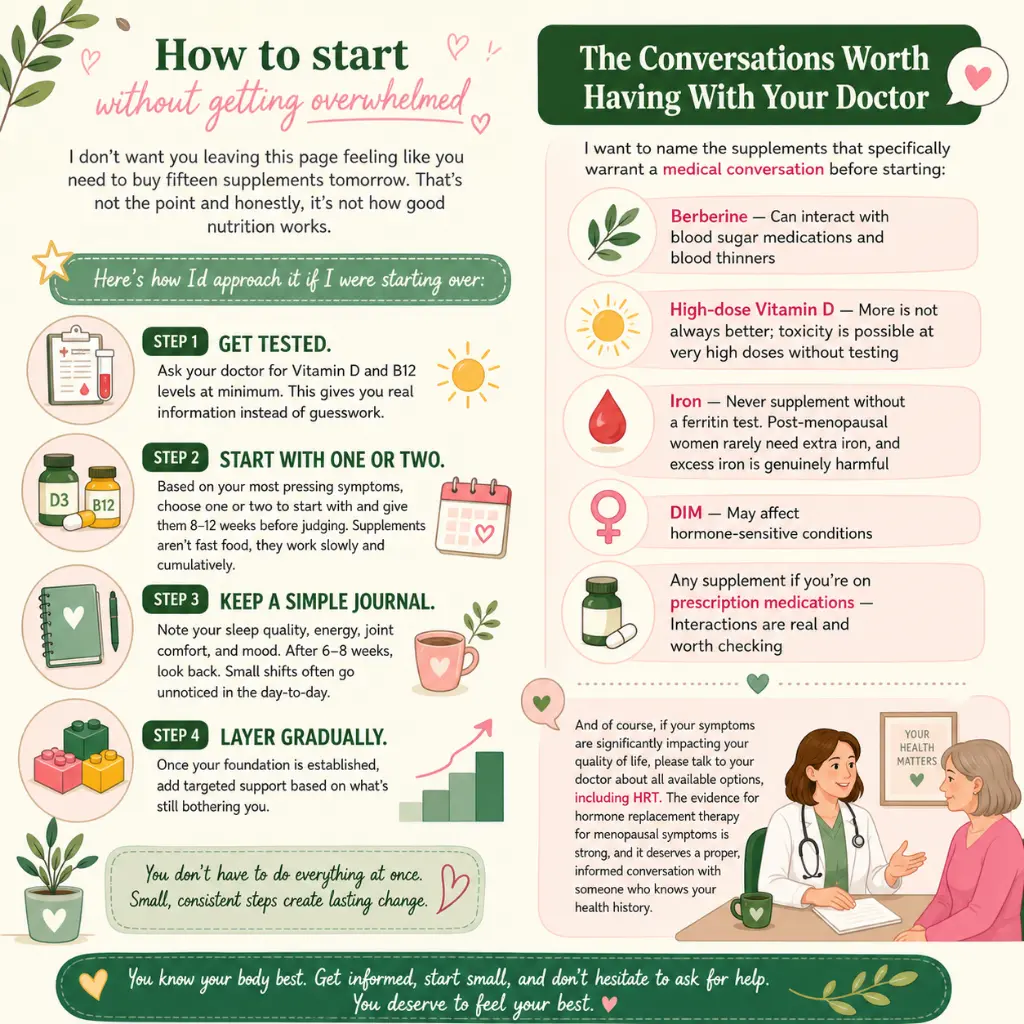
- Identify the reason. Are you correcting a documented deficiency, addressing a dietary gap, or considering a supplement for a specific outcome?
- Review medications and health conditions. Supplements can interact with prescriptions and may not be appropriate for everyone.
- Avoid changing several things at once. A simpler plan makes it easier to understand what you are taking and why.
- Reassess. Do not assume a supplement must be continued indefinitely. Review whether it is still needed and appropriate.
The safety conversation matters
“Natural” does not mean risk-free. The chance of interactions becomes especially important when several supplements are combined or when prescription medications are involved. High-dose nutrients can also cause problems, and products that affect blood sugar, bleeding, sedation, or hormone-related pathways deserve particular care.
If symptoms are significantly affecting your quality of life, discuss the full range of evidence-based options with a qualified healthcare professional. Hormone therapy can be appropriate for certain menopausal symptoms for some women after an individualized assessment of benefits and risks; supplements should not be used as a substitute for that medical conversation.
Resistance training and supplements: keep the priorities clear

A supplement cannot replace the training stimulus your muscles need. Resistance exercise is an important part of maintaining strength and function as we age, while adequate protein and overall nutrition help support that work. If you are new to strength training or have pain, balance problems, osteoporosis, or another medical condition, the right starting point may need to be individualized.

The Most Common Questions Women Ask
How long before I feel a difference from a supplement?
There is no single timeline. It depends on the supplement, why you are taking it, your baseline nutritional status, the outcome being measured, and whether the product is appropriate in the first place. Avoid using a fixed number of weeks as proof that every supplement should work.
Are supplements for perimenopause belly fat actually effective?
No supplement can spot-reduce abdominal fat. Some ingredients are studied for specific metabolic outcomes or populations, but they should not be presented as universal treatments for menopause belly fat. Nutrition, physical activity, sleep, health conditions, and overall energy balance remain important parts of the picture.
What supplements help with perimenopause brain fog?
Brain fog during perimenopause can have several contributors, and no single supplement is a proven universal solution. Nutritional deficiencies such as low B12 should be identified and treated appropriately, while supplements such as creatine and omega-3s have research in broader areas of cognition or health that should not be overstated as menopause-specific treatment.
Do any perimenopause supplements actually work?
Some supplements are useful when they correct a deficiency or address a specific evidence-supported need. Evidence varies substantially by ingredient and outcome, so it is more accurate to evaluate each supplement separately than to treat a group of products as proven perimenopause remedies.
Your Next Step
You don’t have to do everything at once. Start with the reason you are considering a supplement, check whether food or medical evaluation should come first, and make the decision one product at a time. The goal is not a crowded supplement cabinet. It is a plan you can explain, evaluate, and adjust.
Wrapping It Up
Perimenopause asked me to pay attention to my body in a way I never had before. It was uncomfortable, but it also taught me that more products are not the same as better care.
You don’t need a cabinet full of supplements. You need to understand why you are taking each one, what evidence supports that use, and whether it is safe for you. That is a much stronger foundation for navigating supplements for perimenopause and beyond.