

Why am I always tired after 50? If you’re asking this question, you’re not alone. Many women notice a sudden drop in energy, even when they’re getting enough sleep and trying to take care of their health.
The truth is, feeling constantly tired after 50 is often linked to deeper changes in the body, including hormonal shifts, lighter sleep, and slower recovery. It’s not just about how long you sleep, but how well your body actually rests and restores itself.
Understanding this difference is essential. Fatigue after a full night’s sleep does not automatically mean something is wrong. In many cases, it reflects normal changes in how the body rests and recovers. Once this is clear, it becomes easier to approach sleep with less anxiety and more realistic expectations.
In this guide, you’ll discover the real reasons behind this persistent fatigue and what you can do to feel more energized again.
Top Reasons You Feel Tired After Sleeping Enough
Here are the most common reasons behind this constant fatigue:
- Poor Sleep Quality (Not Just Sleep Quantity)
Even if you spend 7–8 hours in bed, your body may not be getting enough deep, restorative sleep. After 50, sleep becomes lighter and more fragmented, which means you wake up feeling tired despite “enough” sleep. - Hormonal Changes After 50
Menopause and hormonal shifts can directly affect your energy levels. Lower estrogen and progesterone can lead to disrupted sleep, night awakenings, and ongoing fatigue during the day. - Frequent Night Awakenings
Many women experience micro-awakenings during the night without fully realizing it. These interruptions prevent your body from reaching deep sleep stages, leaving you feeling drained in the morning. - Slower Metabolism and Recovery
As you age, your metabolism naturally slows down. Your body takes longer to recover, which can result in low energy even after a full night’s sleep. - Stress and Mental Load
Emotional stress, even when it feels manageable, can keep your nervous system active at night. This leads to lighter sleep and a constant feeling of tiredness during the day. - Nutrient Deficiencies
Low levels of key nutrients like vitamin B12, vitamin D, iron, or magnesium can significantly affect your energy levels and make you feel tired all the time. - Caffeine Timing
Caffeine stays longer in your system after 50. Drinking coffee later in the day can silently disrupt your sleep quality, even if you fall asleep easily.
How to Fix Constant Fatigue After 50 (Simple Actions That Work)
If you’re wondering why you’re constantly exhausted after 50, the good news is that reclaiming your energy doesn’t require a radical lifestyle overhaul. Small, intentional shifts can make a profound difference. By focusing on targeted adjustments rather than extreme solutions, you can effectively restore your vitality and feel like yourself again.
Here are simple actions you can start this week:
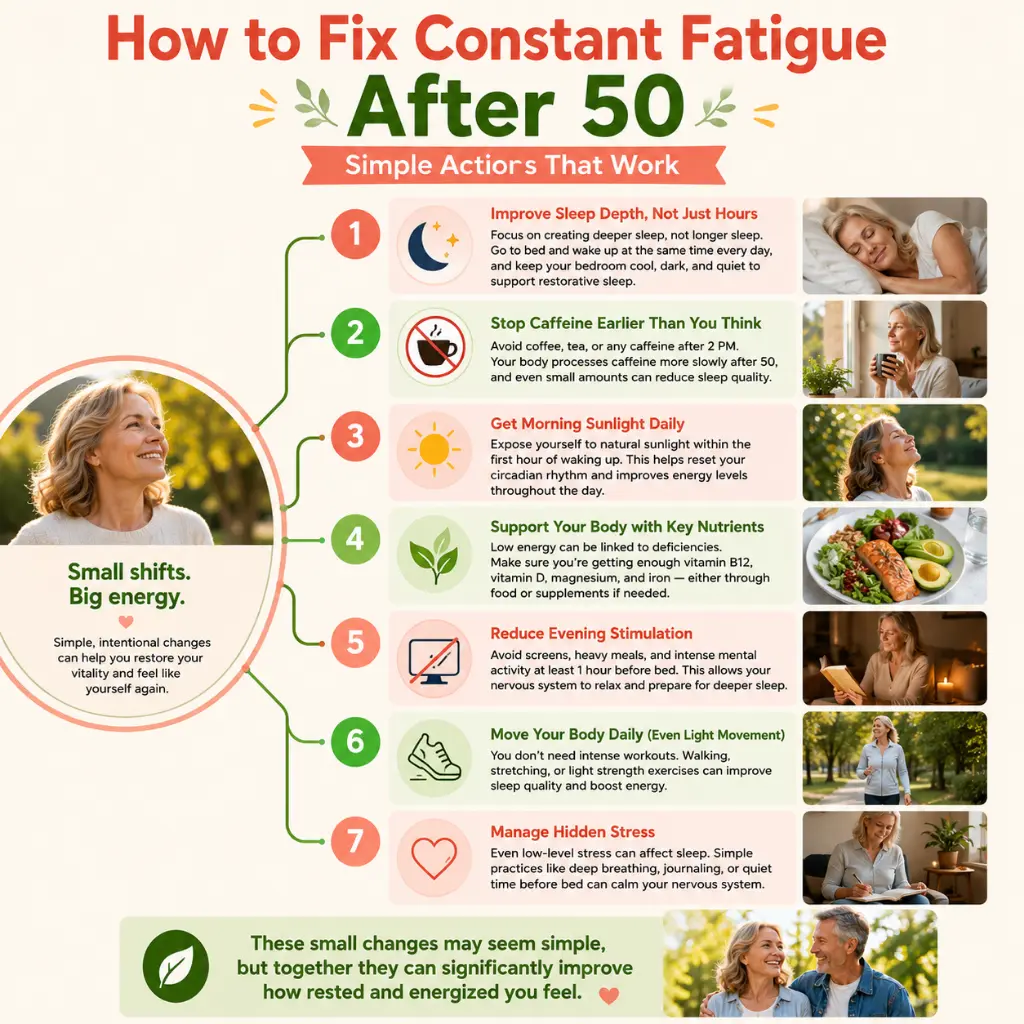
- Improve Sleep Depth, Not Just Hours
Focus on creating deeper sleep, not longer sleep. Go to bed and wake up at the same time every day, and keep your bedroom cool, dark, and quiet to support restorative sleep. - Stop Caffeine Earlier Than You Think
Avoid coffee, tea, or any caffeine after 2 PM. Your body processes caffeine more slowly after 50, and even small amounts can reduce sleep quality. - Get Morning Sunlight Daily
Expose yourself to natural sunlight within the first hour of waking up. This helps reset your circadian rhythm and improves energy levels throughout the day. - Support Your Body with Key Nutrients
Low energy can be linked to deficiencies. Make sure you’re getting enough vitamin B12, vitamin D, magnesium, and iron — either through food or supplements if needed. - Reduce Evening Stimulation
Avoid screens, heavy meals, and intense mental activity at least 1 hour before bed. This allows your nervous system to relax and prepare for deeper sleep. - Move Your Body Daily (Even Light Movement)
You don’t need intense workouts. Walking, stretching, or light strength exercises can improve sleep quality and boost energy. - Manage Hidden Stress
Even low-level stress can affect sleep. Simple practices like deep breathing, journaling, or quiet time before bed can calm your nervous system.
These small changes may seem simple, but together they can significantly improve how rested and energized you feel.
What “Sleeping Enough” Really Means After 50
For many adults, “sleeping enough” is still defined by the number of hours spent in bed. This way of thinking makes sense, but it does not always reflect how sleep functions later in life. After 50, the body’s relationship with rest changes, and the experience of sleep becomes more complex than a simple hourly count.
What matters increasingly is how sleep is structured and how restorative it feels, not just how long it lasts. Lighter sleep, brief awakenings, and reduced time in deeper stages can all affect how refreshed someone feels in the morning. Understanding this distinction helps explain why fatigue can persist even when sleep duration appears sufficient, and it prepares the ground for looking more closely at sleep quality rather than sleep quantity alone. For related Lonage guidance, see menopause sleep, fatigue, brain & mood.
Understanding these causes is the first step toward fixing the problem. Once you identify what’s affecting your sleep and energy, you can start making simple changes that actually work.
Sleep Quality vs. Sleep Quantity
For most of our lives, sleep is measured in hours. Eight hours is considered “good,” six hours is often seen as “not enough.” While this way of thinking is simple, it does not always reflect how sleep actually works, especially later in life.
After 50, sleep quality often matters more than sleep quantity. It is possible to spend enough time in bed but still experience lighter, less restorative sleep. In this case, the body does not move through the deeper stages of sleep as efficiently as it once did. As a result, the brain and muscles may not fully recover overnight.
This is why many adults wake up feeling tired even when their schedule looks healthy on paper. The issue is not laziness or poor discipline. It is a shift in how sleep is structured. Recognizing this difference helps reduce self-blame and opens the door to more effective adjustments.
Micro-Awakenings and Light Sleep: Why Rest Feels Incomplete
Many people assume that waking up briefly during the night means they are not sleeping well at all. In reality, short awakenings, often called micro-awakenings, are a normal part of sleep, especially as we get older. The difference is that after 50, these awakenings tend to become more noticeable.
Instead of moving smoothly from one sleep stage to another, the body may shift more lightly between phases. This can create the feeling of being “half awake,” even if these moments last only a few seconds or minutes. Over the course of the night, these small interruptions add up and can reduce the sense of deep rest in the morning.
What’s important to understand is that these awakenings are not a sign of failure or poor habits. They are often linked to natural changes in sleep structure. Becoming aware of this helps explain why rest can feel incomplete, even when total sleep time appears sufficient.
Why Deep Sleep Matters for Physical and Mental Recovery
Deep sleep plays a crucial role in how the body restores itself. This is the phase of sleep when tissues repair, muscles recover, and the brain processes information from the day. When deep sleep is reduced, rest may feel less effective, even if overall sleep duration remains the same.
After 50, spending less time in deep sleep becomes more common. This does not mean the body stops recovering, but it does mean that recovery can take longer or feel less complete. As a result, fatigue may linger into the morning, and mental clarity may take longer to return after waking.
Understanding the role of deep sleep helps shift expectations. Feeling tired does not necessarily indicate a serious problem or poor sleep habits. In many cases, it reflects natural changes in how the body restores itself overnight. With this perspective, it becomes easier to focus on supporting sleep quality rather than obsessing over the number of hours slept.

Common Reasons This Happens After 50 (Beyond “Bad Habits”)
Feeling tired after a full night’s sleep often leads people to question their routines. They may wonder if they are doing something wrong, sleeping “incorrectly,” or failing to follow the right habits. While daily behaviors do influence sleep, they are rarely the whole explanation especially after 50.
At this stage of life, sleep is shaped by a combination of internal changes and external factors. The body reacts differently to stress, stimulation, and recovery than it did years earlier. Even small influences that once went unnoticed can now have a greater impact on how rested someone feels in the morning.
Understanding these broader influences helps shift the conversation away from blame. Fatigue is not always the result of poor choices. In many cases, it reflects how the body adapts over time. Recognizing this makes it easier to explore adjustments calmly and realistically, without assuming that sleep problems are self-inflicted.
Natural Changes in Sleep Architecture
As we age, the structure of sleep itself evolves. Sleep cycles may become shorter, and the balance between light and deep sleep can shift. These changes are subtle, but over time they influence how restorative sleep feels.
Instead of moving through long, uninterrupted periods of deep sleep, the body may spend more time in lighter stages. This does not mean sleep becomes ineffective, but it does mean that recovery feels different. The morning sense of refreshment that once came easily may take longer to appear.
Recognizing these structural changes helps explain why fatigue can persist even when sleep duration looks adequate. It also reinforces the idea that feeling tired is not necessarily a sign of doing something wrong; it is often a reflection of how sleep naturally changes with age.
How Hormonal Shifts Influence Sleep Differently for Women
For women, sleep changes after 50 are often linked to menopause and the years that follow. Hormonal fluctuations can make sleep feel lighter, less predictable, or harder to sustain throughout the night.
These shifts do not affect everyone in the same way. Some women notice night sweats or temperature sensitivity, while others experience more fragmented sleep without an obvious physical cause. What remains consistent is that sleep often becomes more sensitive during this period.
This is not a permanent condition, and it does not mean sleep will remain difficult indefinitely. The body adjusts over time, and understanding this transition helps reduce unnecessary concern. Small, supportive changes in routine or environment can often make a meaningful difference as the body finds its new rhythm.
Recognizing that these sleep changes are part of a natural process, not a personal failure, allows for a calmer, more patient approach.
Stress Response and Mental Load
Stress does not disappear as life moves forward; it simply changes form. Concerns about health, family, finances, or daily responsibilities can keep the nervous system more alert, even during rest. After 50, the body may take longer to fully settle into a relaxed state at night.
This heightened sensitivity can lead to lighter sleep or more frequent awakenings, even when stress does not feel overwhelming during the day. Importantly, this is not a failure to “relax properly.” It reflects how the brain and nervous system respond differently to pressure over time.
Understanding this connection helps remove guilt from the conversation. Difficulty sleeping does not mean someone is unable to manage stress. It often means the body needs more support to transition into rest.
Environment and Routine: Small Factors That Add Up
Sleep becomes more sensitive to the surrounding environment with age. Light, noise, temperature, and even subtle disruptions can have a stronger effect than before. What once seemed insignificant may now interfere with rest more noticeably.
Daily routines also play a role. Evening stimulation, irregular schedules, or inconsistent wind-down habits can make it harder for the body to shift into sleep mode. Individually, these factors may seem minor, but together they can influence how restorative sleep feels.
The key is not to aim for perfection, but awareness. Small adjustments, made gradually, often have a meaningful impact. When the environment and routine better support rest, the body is more likely to recover efficiently overnight.
How Caffeine Timing Affects Rest Later in Life
Caffeine metabolism slows with age, which means coffee or tea consumed in the afternoon may still influence sleep hours later. Many adults do not realize that their body processes stimulants differently than it did in earlier decades.
This does not mean eliminating caffeine entirely. For most people, enjoying coffee or tea earlier in the day, typically before early afternoon, allows the body enough time to process it before bedtime.
What matters is awareness. Paying attention to how caffeine affects your own rest, rather than following strict rules, helps identify the timing that works best for you. Small adjustments in when caffeine is consumed can often improve sleep quality without requiring major sacrifices.

What You Can Do This Week to Feel More Rested
When sleep feels unsatisfying, the natural reaction is often to look for big solutions. New supplements, strict rules, or drastic changes can seem appealing. In reality, meaningful improvements usually come from small, consistent adjustments, especially after 50.
At this stage of life, the goal is not to force deeper sleep, but to support the conditions that allow rest to happen more naturally. Simple actions, repeated regularly, help the body feel safer, calmer, and more prepared for recovery at night.
These steps are not about perfection. They are about creating a rhythm that works with the body rather than against it. Even modest changes can gradually improve how rested you feel in the morning.
A Simple Bedtime Routine That Supports Deeper Rest
A consistent bedtime routine helps signal to the body that it is time to slow down. This does not require elaborate rituals. What matters most is repetition and calm.
Doing the same few things each evening such as dimming the lights, reading quietly, or practicing slow breathing, helps the nervous system transition out of alert mode. Over time, the body begins to associate these cues with rest.
For adults over 50, this predictability is especially helpful. It reduces mental stimulation and lowers nighttime tension. Rather than trying to fall asleep quickly, the focus shifts to preparing the body for rest in a gentle, reliable way.
Daytime Habits That Improve Nighttime Sleep
Sleep does not begin at bedtime. What happens during the day influences how easily the body rests at night. Exposure to natural light, regular movement, and balanced activity all support a healthier sleep-wake cycle.
Simple habits—such as spending time outdoors in the morning or avoiding long periods of inactivity, help reinforce the body’s internal rhythm. These actions do not need to be intense to be effective.
By supporting sleep earlier in the day, nighttime rest often becomes more stable. This approach feels more manageable than trying to “fix” sleep only when it becomes a problem at night.
When to Consider Extra Support
Sometimes, fatigue persists despite thoughtful adjustments. When this happens, it does not automatically signal a serious issue. It may simply mean that the body needs additional support or guidance.
Paying attention to ongoing patterns, rather than isolated nights, helps determine when to seek advice. This might involve discussing sleep concerns with a healthcare professional or exploring structured support options.
The key is balance. Seeking help is not a sign of failure, and it does not mean something is wrong. It is simply another way to better understand how your body is responding and what it needs to rest more effectively.
Feeling tired despite sleeping enough can be confusing and discouraging, especially later in life. Understanding that this experience is often linked to changes in sleep quality, not personal failure, helps shift the conversation in a healthier direction. After 50, sleep becomes more sensitive to biological rhythms, mental load, and daily routines, even when time in bed seems sufficient.
The good news is that this awareness creates clarity. Once the difference between sleep quantity and sleep quality is understood, it becomes easier to approach rest with more patience and realistic expectations. Fatigue is not always a sign that something is wrong it is often a signal that the body needs support, not pressure.
Frequently Asked Questions
Why am I always tired after 50 even after sleeping enough?
This usually happens because sleep quality changes with age. After 50, the body spends less time in deep sleep, making it harder to feel fully rested even after 7–8 hours in bed.
Is it normal to feel exhausted after menopause?
Yes, many women experience fatigue after menopause due to hormonal changes, lighter sleep, and slower recovery. While it’s common, it can be improved with the right habits and support.
What deficiency causes constant fatigue after 50?
Common deficiencies linked to fatigue include vitamin B12, vitamin D, iron, and magnesium. Low levels of these nutrients can reduce energy and affect sleep quality.
When should I worry about constant fatigue?
If fatigue persists despite improving sleep, nutrition, and lifestyle habits, it may be worth consulting a healthcare professional to rule out underlying conditions.
How can I increase my energy after 50 naturally?
You can improve energy by getting daily sunlight, maintaining a consistent sleep schedule, reducing caffeine intake, and staying physically active, even with light exercise.
Moving Toward More Restful Mornings
Feeling tired after a full night’s sleep is confusing, and often discouraging. The issue is that sleep after 50 works differently than it did earlier in life, and duration alone no longer guarantees restoration.
What matters increasingly is sleep quality, how deeply the body rests and how much time is spent in restorative phases. When these elements are compromised, fatigue can persist despite adequate hours in bed. This is not a personal failure. It reflects natural changes in sleep architecture, hormonal balance, and nervous system sensitivity.
Understanding this distinction helps shift expectations. Better sleep does not require perfection or drastic intervention. In many cases, it comes from small, gradual adjustments: calming routines, attention to environment, awareness of stress patterns, and patience with the process itself.
Improvement is possible, though it may take time. Rather than forcing sleep, supporting the conditions that allow rest to happen naturally often leads to steadier progress.
In the next article, we will explore practical and natural ways to improve sleep after 50, focusing on gentle strategies that help the body rest more effectively over time.
For broader guidance on this topic, explore our menopause after 50 hub.
Another related cause is low energy and circulation after 50.