

I was sitting across from my friend Mia at our favorite spot in Santa Monica when she said something that stopped me mid-sip: “I feel like I’m running on empty and I genuinely don’t know why.” She wasn’t sick. She wasn’t overwhelmed. But something felt deeply off. Sound familiar?
What so many of us discover in our 50s is that the signs of vitamin deficiency can be incredibly easy to miss. Fatigue, brain fog, brittle nails, hair changes, or tingling can all make us wonder whether nutrition is part of the picture. But these symptoms are not specific to vitamin deficiency, and they can also happen with sleep problems, thyroid conditions, anemia, medication effects, menopause-related changes, or other health issues.
That distinction matters. The goal is not to look at one symptom and decide which vitamin you need. It is to recognize patterns that may be worth discussing with a healthcare professional, especially when they persist, worsen, or affect your daily life.
For the broader nutrition context, our guide to vitamins and nutrients for women over 50 explains where vitamin D, calcium, B12, magnesium, zinc and other nutrients fit into a food-first approach after 50.
Why vitamin deficiency can be harder to spot after 50
Here’s something nobody really warns us about before we get here: a lot can change after 50, but not every change has one neat nutritional explanation. Appetite, eating patterns, medications, digestive conditions, previous gastrointestinal surgery, time spent indoors, and overall food variety can all influence nutrient status.
Some nutrients also deserve more attention as we age. Vitamin B12, for example, can become harder to absorb from food in some older adults. Calcium and vitamin D remain important for bone health, and iron status can still matter when fatigue or other symptoms are present. But age by itself does not prove that any one nutrient is low.
Lowkey, this season of life calls for a deeper level of body awareness. The useful question is not “Which deficiency do I have?” but “Is this symptom persistent enough that I should investigate it rather than guess?”
Signs of vitamin deficiency: 7 common clues worth investigating
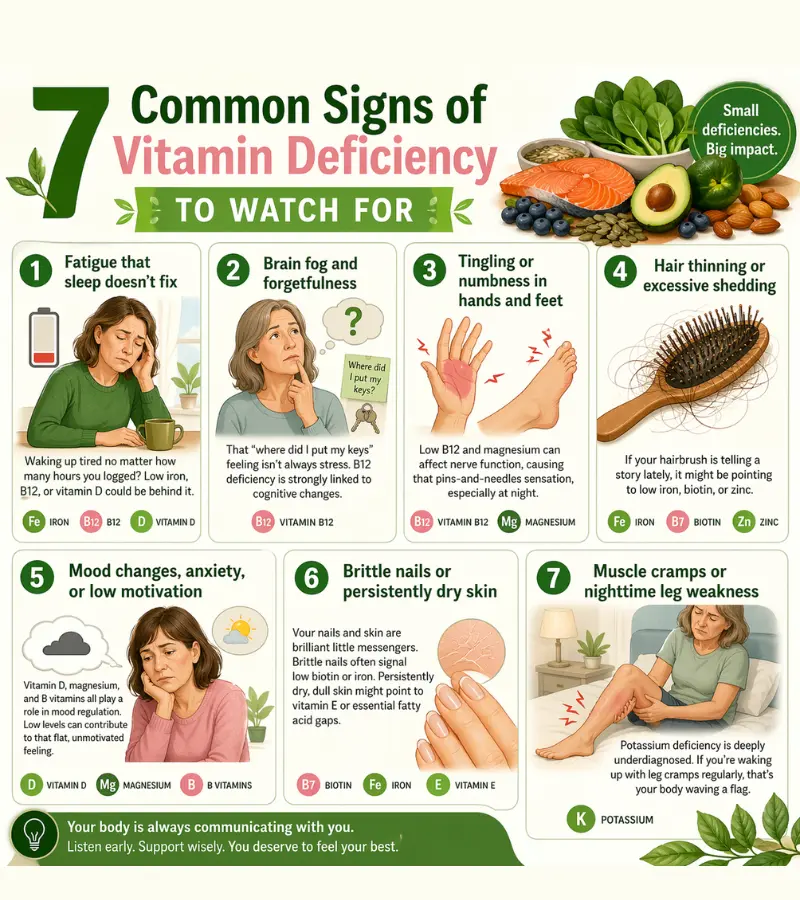
This is the section I wish someone had handed me years ago. Because some of these signs are so easy to dismiss as “just stress” or “just age.” The important part is knowing that they are nonspecific. A symptom can point you toward a conversation with your clinician, but it cannot tell you which nutrient is low.
1. Fatigue that does not improve with rest
Persistent fatigue has many possible causes. Nutritional problems such as iron or vitamin B12 deficiency may be considered alongside poor sleep, thyroid conditions, depression, medication effects, and other health issues. Vitamin D status may also be relevant in some clinical contexts, but fatigue alone cannot identify a specific deficiency. If it keeps showing up, it is worth investigating rather than automatically reaching for a supplement.
2. Brain fog or noticeable changes in concentration
Difficulty concentrating or feeling mentally slower can overlap with sleep disruption, menopause, stress, thyroid conditions, medication effects, anemia, and vitamin B12 deficiency. If the change is new, persistent, or affecting daily function, it deserves proper evaluation.
3. Tingling or numbness in the hands or feet
Vitamin B12 deficiency is one possible cause of neurological symptoms such as tingling or numbness, but it is far from the only one. Diabetes, nerve compression, medication effects, and other neurological conditions can produce similar symptoms. Persistent numbness or weakness should not be self-diagnosed as a vitamin problem. If B12 is one of the possibilities you are trying to understand, our Vitamin B12 and B-Complex guide for women over 50 explains when supplementation may deserve consideration, how B12 differs from a B-complex, and why symptoms alone are not enough to choose a supplement.
4. Hair thinning or increased shedding
Hair shedding can sometimes be associated with low iron, zinc, or other nutritional problems, but hormonal changes, thyroid disease, stress, medications, and genetic hair loss are also common. The pattern, timing, and accompanying symptoms matter.
5. Mood changes or low motivation
Nutrient status can be one piece of a much larger picture, but mood changes should never be reduced to a vitamin explanation. Sleep, stress, menopause symptoms, mental health conditions, medications, and medical illness can all contribute. If low mood persists, seek appropriate professional support rather than relying on supplements alone.
6. Brittle nails or persistent skin changes
Nails and skin can change for many reasons, including dryness, repeated chemical exposure, thyroid problems, aging, and nutritional gaps. Iron or zinc status may be relevant in some cases, but appearance alone cannot identify a deficiency.
7. Muscle cramps or weakness
Muscle cramps are common and can be related to activity, hydration, medications, circulation, nerve issues, or electrolyte disturbances. Magnesium or potassium may be part of the picture in some situations, but regular or severe cramps should be assessed in context rather than treated as proof of a specific deficiency.
Symptoms are clues, not diagnoses
This is the most important idea in the article. A symptom can help you notice that something deserves attention, but it cannot reliably tell you whether the issue is vitamin B12, vitamin D, iron, magnesium, thyroid function, sleep, medication effects, or something else entirely.
That is why “symptom matching” can be misleading. Fatigue appears in countless conditions. Tingling has many possible neurological causes. Hair loss can be nutritional, hormonal, genetic, or stress-related. Dry skin can happen without any vitamin deficiency at all.
I know that sounds less satisfying than a quick checklist, but it is much more useful. You do not need to guess your way through five bottles of supplements. You need the right question, the right context, and sometimes the right test.
When testing may make sense
Testing is most useful when it is guided by symptoms, diet, medication use, medical history, and risk factors rather than ordered as a random search for every possible deficiency.
A clinician may decide to investigate specific nutrients when symptoms persist, when your diet excludes major food groups, when gastrointestinal disease or surgery may affect absorption, when certain medications are involved, or when another medical finding raises concern.
And this is where context matters more than internet thresholds. A laboratory result has to be interpreted alongside your symptoms, medications, health history, and the reference range used by that laboratory. One number should not be turned into a supplement plan without understanding why it is high or low.
What food can and cannot do
I love practical food strategies because they feel doable. A varied diet that includes vegetables, fruit, legumes, whole grains, nuts, seeds, dairy or fortified alternatives, eggs, fish, and other appropriate protein sources can help cover a wide range of micronutrients. For the broader food-first framework, our guide to what to eat after 50 explains how everyday food choices can support nutrition after 50. When B12 is the nutrient you want to focus on through meals rather than supplements, our natural sources of B12 for women over 50 guide covers food and fortified-food options in detail.
But no single fruit, tea, smoothie, or morning ritual can diagnose or correct every nutrient deficiency. Lemon water does not replace evaluation of low B12. Pomegranate is not a treatment for vitamin D deficiency. Papaya can be a nutritious food, but it should not be presented as a tool that reliably fixes vitamin absorption problems.

The more useful food-first strategy is much less glamorous: eat a varied pattern consistently, pay attention to foods that provide the nutrients you may be at risk of missing, and use supplements when there is a clear reason for them.
When symptoms need prompt medical attention
Some symptoms should not be filed under “maybe I need vitamins.” New or worsening weakness, significant numbness, difficulty walking, fainting, chest pain, shortness of breath, severe confusion, unexplained weight loss, or rapidly worsening symptoms deserve medical attention.
The same applies when fatigue is severe, when neurological symptoms are progressing, or when you have a medical condition or medication that could affect nutrient status. Supplements should never delay evaluation of a potentially important medical problem.
The most common questions women ask
How do you know if you have a vitamin deficiency?
Symptoms can raise suspicion, but they cannot confirm a vitamin deficiency on their own. The most useful approach is to discuss persistent symptoms, diet, medications and medical history with a healthcare professional, who can decide whether targeted testing is appropriate.
What are common signs that may be linked to poor nutrition or nutrient deficiency?
Possible clues include persistent fatigue, concentration problems, tingling or numbness, hair or nail changes, muscle weakness, and some skin changes. These symptoms are nonspecific and can also occur with many medical conditions, so they should not be used for self-diagnosis.
Can cravings tell you that your B12 is low?
No reliable craving pattern can diagnose vitamin B12 deficiency. Cravings for meat, eggs, dairy, salty foods or other foods are not a dependable way to determine B12 status. If B12 deficiency is a concern, symptoms and risk factors should be assessed in the appropriate clinical context.
Should every woman over 50 take vitamin supplements?
No. Supplement needs depend on diet, health conditions, medications, absorption issues, laboratory findings and other individual factors. A food-first approach is appropriate for many women, while targeted supplementation may be useful when there is a clear reason.
A calmer way to read your body
Recognizing the signs of vitamin deficiency can be genuinely empowering, but only when we use those signs the right way. Your body may be giving you useful information. It is not necessarily giving you a diagnosis.
We’ve covered fatigue, brain fog, tingling, hair and nail changes, mood shifts, skin changes, and muscle cramps. Any of these can be a reason to look more closely at your nutrition and health, especially when the pattern is persistent.
I’m still all for paying attention to the small signals. I just want us to do it without turning every symptom into a deficiency or every deficiency into a supplement routine.
If something keeps feeling off, bring the pattern to your doctor or another qualified healthcare professional. A targeted evaluation can give you a much clearer starting point than guessing from symptoms alone.