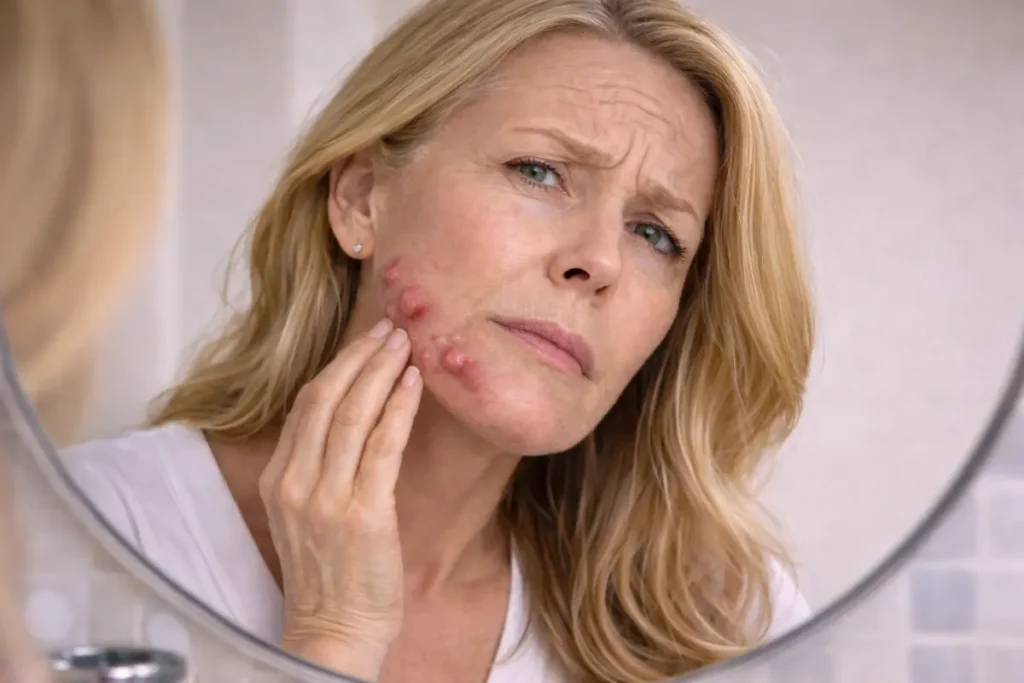
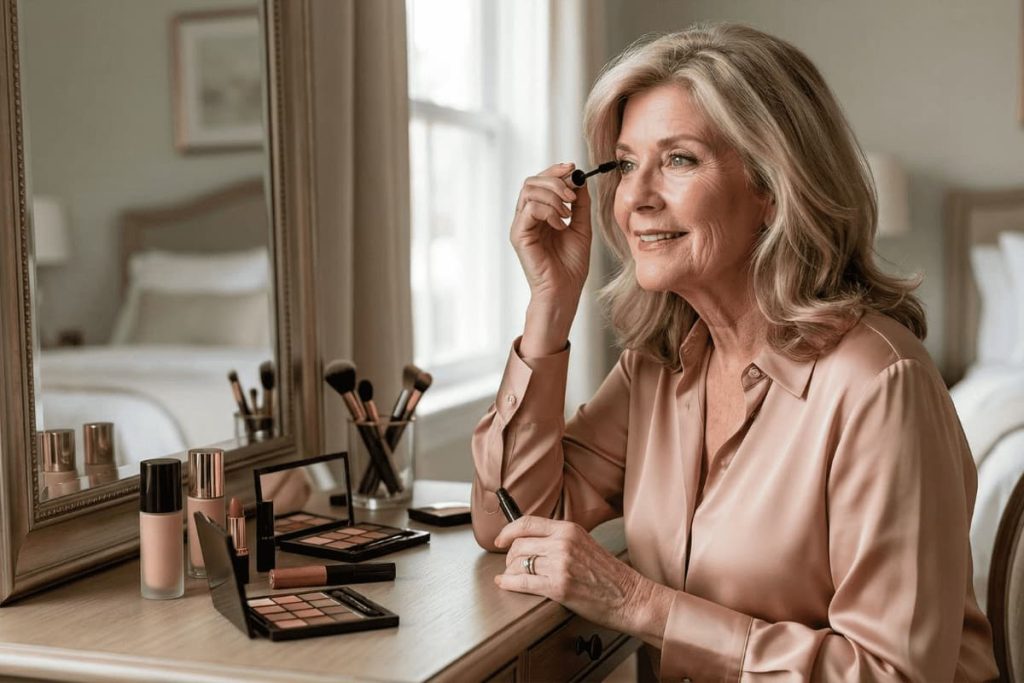
You used to line your eyes in sixty seconds without even looking; now that same liner smudges, creases, or disappears entirely within an hour. Sound familiar? You’re not alone. Eye makeup for women 50 and beyond requires a genuinely different approach, and once you understand why, everything gets easier.
Your eyes change after 50. Lids become a little heavier. The skin around your eyes gets thinner and drier. Lashes thin out in many women; the onset of hormonal changes makes the delicate eye area more sensitive than ever before. None of this means you can’t wear beautiful, expressive eye makeup. It means your technique and your products need to evolve with you.
The good news. Women over 50 who master a few key adjustments almost always say their eye makeup looks better now than it ever did, more polished, more intentional, and more authentically them.
In this guide, you’ll find everything you need: which products actually work on mature eyes, step-by-step techniques for liner, shadow, mascara, and the small shifts that make the biggest visual difference. Let’s get into it.
Why eye makeup feels different after 50
Before you can fix what isn’t working, it helps to understand what’s actually changed. The answer, as with so much in midlife, starts with hormones.
Estrogen plays a direct role in the health of the skin around your eyes. It supports collagen production, maintains skin thickness, and keeps the tear film stable. When estrogen declines during perimenopause and menopause, the skin around your eyes becomes thinner, drier, and more prone to crepiness. The eyelids themselves may feel heavier due to a subtle loss of elasticity in the orbital area.
Many women also notice that their eyes feel drier and more sensitive after menopause. This is because estrogen supports the meibomian glands, which produce the oil layer of your tear film. When the oil layer is reduced, eyes become more reactive to products applied nearby, including eyeliner and mascara.
Lashes naturally thin and lighten with age. The lash line itself may appear less defined. And hooded lids, where the brow bone descends slightly over the lid, become more common after the 50s, making traditional eyeshadow application techniques less effective.
None of these changes presents problems to solve; they’re shifts to understand. Once you understand what’s happening, you can identify products and techniques that work with your skin, as well as how hormonal changes affect your skin and beauty routine at this stage. Understanding how menopause affects your skin and daily energy helps you connect everything with clarity.
The best eye makeup products for mature eyes
Product choice makes a difference for 50; not all formulas are created equal, and some popular products that work beautifully on younger skin can actually make mature eyes look more tired, smaller, or older.
For eyeliner, a soft pencil or a felt-tip liner with a fine tip is your best choice. Hard pencils can drag on thin skin and irritate. Liquid liner with a stiff brush requires a steady hand and a smooth lid surface, which can be achieved with hooded or crepey lids. A soft, slightly waxy pencil glides on without tugging and can be smudged easily for a more diffused, forgiving effect.
For eyeshadow, cream or mousse formulas tend to perform better on mature lids than traditional pressed powders, which can collect in fine lines and fade quickly without a primer underneath. Cream shadows blend beautifully with fingertips and tend to stay in place longer on drier skin.
If you prefer powder shadows, always apply an eyeshadow primer first. This one step dramatically improves how long the shadow stays in place and prevents the creasing and fading that many women over 50 find frustrating.
For mascara, look for a formula that is buildable, non-flaking, and easy to remove. Tubing mascaras, which form a tube around each lash rather than coating them with traditional pigment, are particularly popular among women over 50 because they don’t smudge, and remove cleanly with warm water.
Eyeliner techniques that open and lift mature eyes
This is where technique matters more than any product. The goal for eye makeup for women 50 is always the same: open the eye, add definition, and create the impression of lift without heaviness.
Line the upper lash line only. Lining the lower lash line with a dark pencil is one of the most common mistakes that makes eyes look smaller and more tired. It closes the eye down visually and can accentuate under-eye shadows. Save your liner for the top.
Apply liner as close to the upper lash line as possible, working in small strokes rather than one continuous line. You don’t need to connect the line perfectly from the inner to the outer corner. A slightly imperfect line that follows the lashes looks more natural and less harsh than a rigid, perfect stroke.
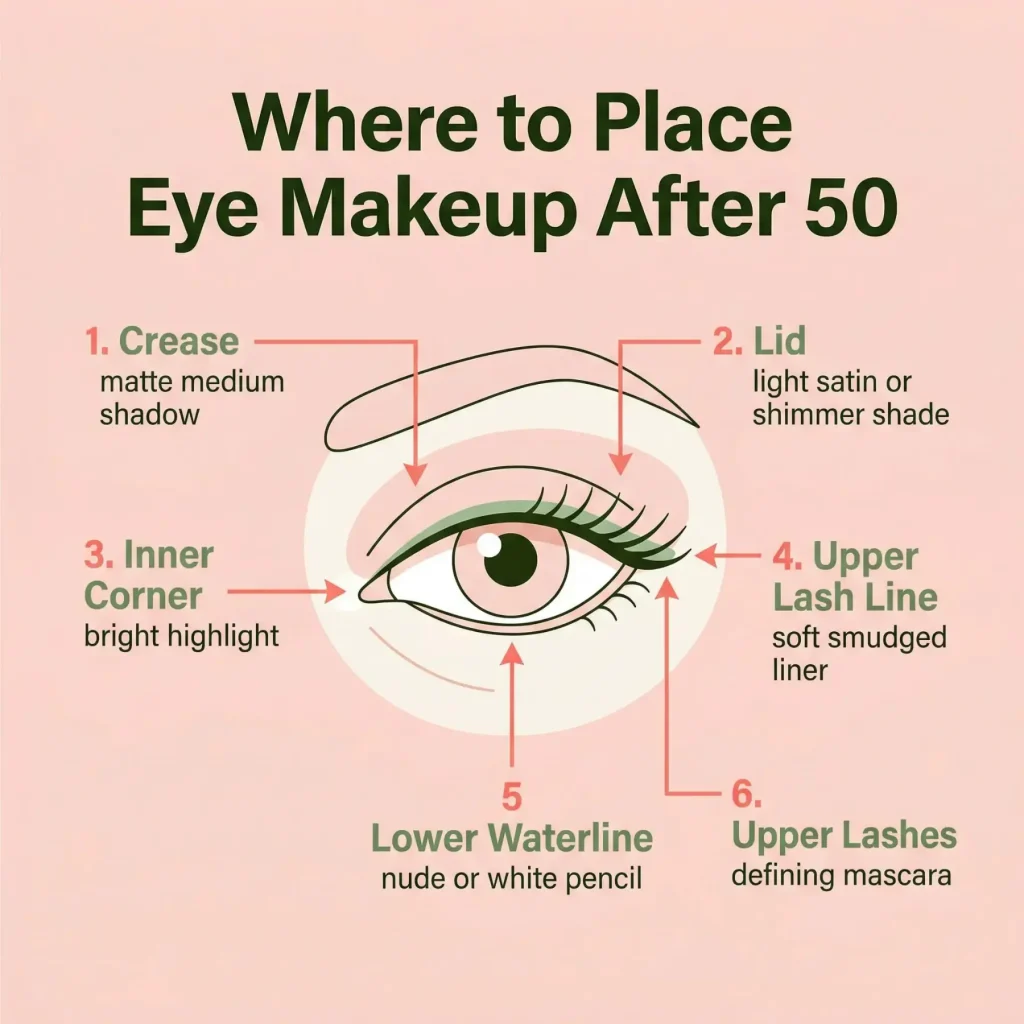
Use a nude or white pencil on the lower waterline. This is genuinely transformative. A nude or soft white pencil applied to the inner rim of the lower lid instantly brightens the eyes, makes the whites cleaner, and creates the illusion of a more awake, open eye. It takes ten seconds and costs almost nothing.
For a subtle lift at the outer corner, extend your liner slightly upward at the very end of the upper lash line, just a few millimetres, angling toward the tail of your brow. This tiny flick creates a visual lift that works beautifully on hooded or downturned eyes.
Avoid tight-lining (lining the upper waterline) if your eyes feel dry or sensitive. It can block the meibomian gland openings and worsen dryness over time.
Eyeshadow placement for a bright, lifted look
Many women over 50 either avoid eyeshadow entirely because past attempts looked unflattering, or they stick to the same look they’ve worn for decades. Both are understandable, and both can change with a few simple adjustments to placement.
The most important shift is this: place your darkest shade in the crease, not on the lid. On hooded eyes, shadow applied all over the lid often disappears when the eyes are open. Shadow placed in the crease, slightly above where your lid naturally creases, stays visible and adds depth and dimension.
Use a matte medium-toned shade (taupe, soft brown, mauve, or warm grey) in and just above the crease, blending upward toward the brow bone. This creates definition and a subtle lifting effect without heaviness.
On the lid itself, choose a lighter, more luminous shade. A soft champagne, warm ivory, or peachy nude on the lid reflects light and is more open. Avoid dark or glittery lid shades, which can make hooded eyes look heavy and draw attention to texture.
A satin or soft shimmer highlight on the inner corner of the eye is one of the fastest ways to brighten tired-looking eyes. Tap a tiny amount of a light, finely milled shimmer shade right at the inner corner where the upper and lower lash lines meet. The effect is instant brightness and openness.
Blend everything thoroughly. Harsh edges are more visible on mature skin than on younger skin because there is less natural “cushioning.” A well-blended eye look always looks polished, intentional, and more flattering, regardless of the colors you choose. For step-by-step guidance on building a complete makeup routine that works for your whole face, the full guide on how to apply makeup over 50 covers every step from primer to lip color.
Mascara tips that make lashes look fuller after 50
Lashes thin and lighten naturally after 50, and finding a mascara approach that genuinely adds volume and definition without clumping, flaking, or smudging is one of the most common challenges in eye makeup for women 50.
Curl your lashes before applying mascara. This single step makes a more visible difference than almost any other mascara technique. A lash curler used at the base of the lashes before mascara opens the eye dramatically and creates a lifted effect that lasts all day. Heated lash curlers, which use a gentle warming element, tend to hold the curl better on straight or downward-pointing lashes.
Apply mascara to the upper lashes only, or very lightly to the lower lashes. Heavy lower lash mascara can make eyes look smaller and emphasize under-eye shadows. If you do apply mascara to your lower lashes, use the tip of the wand and apply just a single light coat.
Use a lengthening or defining mascara rather than a volumizing one if your lashes are fine or sparse. Volumizing formulas can clump on thin lashes and be heavy; a lengthening formula
lashes cleanly and adds visible definition without bulk.
Consider a lash tint or lash lift between makeup days. Both are salon treatments that take about forty-five minutes and make your natural lashes look defined and lifted, even without mascara. Many women over 50 find that this reduces their daily makeup time.
If mascara consistently irritates your eyes, check the formula for potential sensitizers, including fragrance, certain preservatives, and waterproof formulas that require harsh removers. A clean or ophthalmologist-tested formula may make a significant difference.
Brows: the frame that elevates every eye look
Here’s something many women don’t fully appreciate until they try it: well-groomed, well-defined brows have more impact on how your eyes look than any eyeshadow palette you’ll ever own.
Brows naturally thin, lighten, and lose definition after 50. The tail of the brow often disappears first. When brows are sparse or faded, the eyes lose their natural frame and can look undefined regardless of how much eye makeup is applied.
Fill brows with a fine pencil or brow powder, using short, hair-like strokes rather than drawing a solid line. Choose a shade one or two tones lighter than your natural brow color for the most natural result. Dark, heavily drawn brows look harsh on mature faces and draw the wrong kind of attention.
Pay special attention to the tail of the brow, the outer third that tends to disappear first. Extending and defining this area creates a subtle lifting effect on the whole eye area. Aim for a slightly arched shape, with the highest point of the arch sitting above the outer edge of the iris.
Brow gel is an underused tool for women over 50. A clear or tinted brow gel brushes hairs into place, adds a little color, and keeps everything in position throughout the day. Feathery or unruly brow hairs, which become more common with age, respond beautifully to a light coat of brow gel.
If your brows have thinned significantly, microblading or powder brow treatments performed by a certified professional can restore natural-looking fullness that lasts one to two years. It’s worth exploring if sparse brows are affecting your confidence. Building a self-care practice that supports how you look and feel every day is part of the broader work of thriving in healthy aging after 50, and your brows are a meaningful part of that picture.
Frequently asked questions:
Your eyes tell your story; let them shine.
Eye makeup for women 50 isn’t about covering up or turning back time. It’s about understanding your eyes as they are right now and enhancing them with intention, skill, and a little joy. The right technique and the right products can make a genuinely beautiful difference, and once you find your updated approach, you may wonder why it took so long to make the switch.
Start with one adjustment this week. Maybe it’s swapping your lower liner for a nude pencil. It’s curling your lashes before mascara for the first time. Small changes, tried consistently, create real results. And if you experience any eye sensitivity, dryness, or irritation with makeup products, your ophthalmologist or dermatologist is always the right person to guide you. What small step will you try this week?