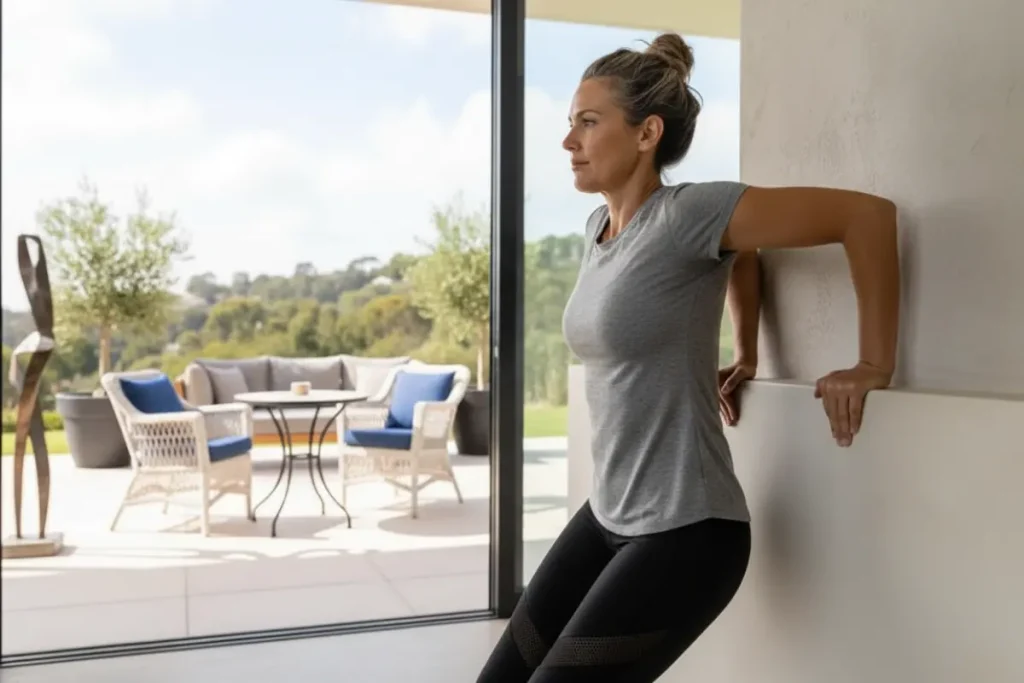
Starting strength training after 60 can feel intimidating, especially if you have been inactive, have joint concerns, or are unsure which exercises are appropriate for you. The goal is not to train like a younger athlete. It is to build a practical routine that supports strength, balance, confidence, and everyday function at a pace that fits your starting point.
This guide focuses specifically on strength training for women over 60: beginning or returning after inactivity, adapting movements for balance or joint concerns, training at home, progressing gradually, and recognizing when professional guidance matters. For the broader principles behind resistance exercise after midlife, see our complete strength training guide for women over 50.
Why strength training after 60 deserves an individual starting point
Two women can both be 65 and have completely different starting points. One may walk every day and have years of exercise experience. Another may be returning after surgery, a fall, prolonged inactivity, joint pain, or a new health diagnosis.
Before choosing exercises, consider how comfortably you can sit and stand, walk, use stairs, reach, balance, and recover from activity. A history of falls or fractures, significant pain, recent surgery, chest symptoms, dizziness, severe shortness of breath, uncontrolled medical conditions, or uncertainty about safe movement can be reasons to seek individualized guidance before progressing on your own.
What strength training can support in everyday life
Resistance exercise can help train the muscles used in ordinary tasks. Depending on your starting point and program, that may translate into greater ease or confidence with movements such as getting up from a chair, carrying groceries, climbing stairs, or handling objects around the home.
Strength training is also one component of healthy aging, but it is not a guarantee against falls, fractures, osteoporosis, disability, or other age-related changes. Balance training, medical care, nutrition, vision, medications, home hazards, and other factors may matter too.
Starting strength training at home after 60
You do not need a gym to begin. A sturdy chair, a wall, resistance bands, dumbbells, or body-weight movements can provide useful options. What matters is choosing a setup that is stable and a level of resistance you can control.
If you are returning after a long break, start with a manageable amount of work rather than trying to match someone else’s schedule. General adult physical-activity guidance includes muscle-strengthening activity on at least two days per week, but that is population-level guidance, not a personal prescription for how much you should do in your first week.
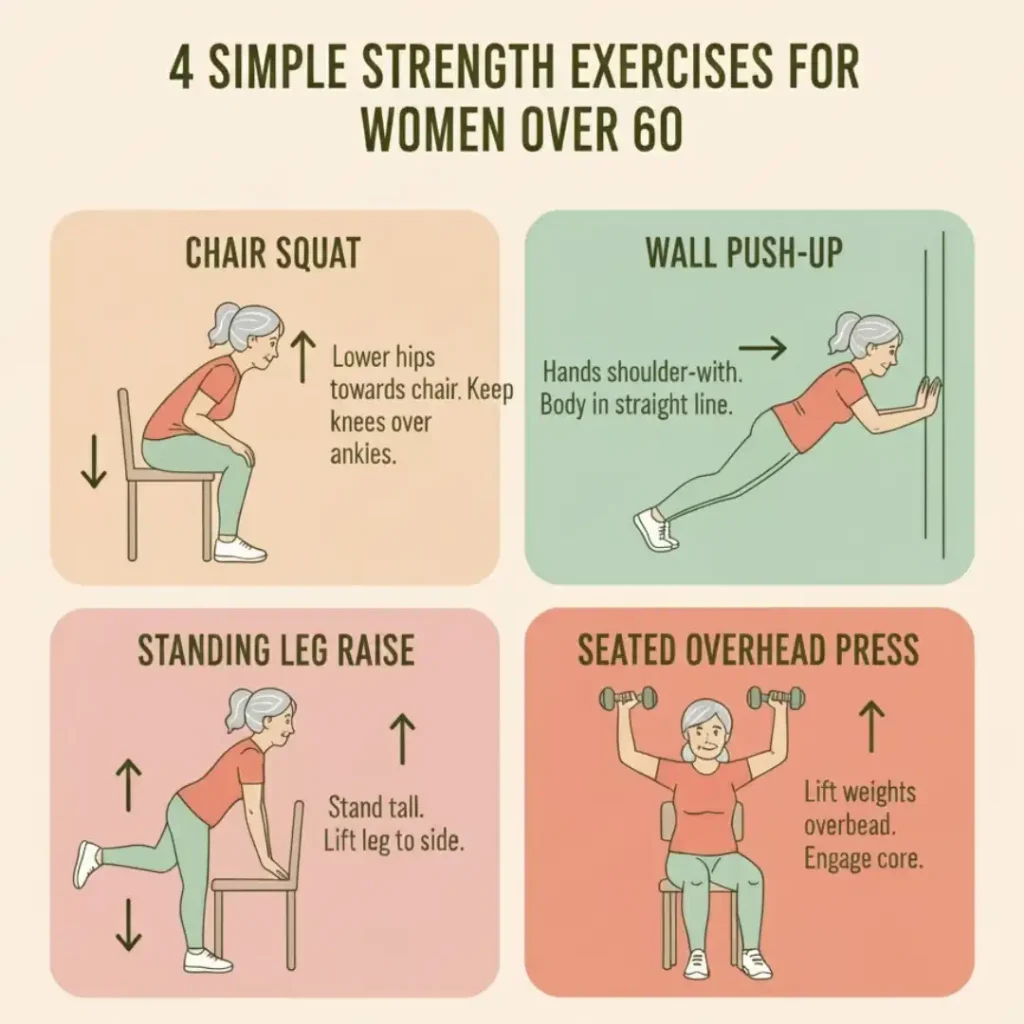
Four movements that can be adapted after 60
Chair sit-to-stand: Use a stable chair and a comfortable foot position. Your hands can provide support if needed. Chair height and range of motion can be adjusted to your ability.
Wall push-up: Stand at a distance that lets you control the movement. Moving closer to the wall can reduce the challenge, while a different angle may increase it.
Supported side or leg movement: Use a stable support if balance is uncertain and keep the range small enough to stay controlled. Avoid relying on furniture that can slide or tip.
Seated or standing upper-body resistance: Light dumbbells or bands can be used for appropriate upper-body movements. Overhead pressing is not necessary for everyone; shoulder symptoms, mobility, and medical history may require another variation.
These are examples, not a mandatory routine. If you want a structured session after you are comfortable with the basics, our full-body workout for women over 50 provides a routine that can be adjusted to your ability.
Choose your support before choosing your weight
Check the environment first: clear the space around you, use a chair that will not slide, and place any stable support within easy reach. Then choose the exercise version. If standing without support feels uncertain, do not make the session harder by removing support just to match a picture. Ask for individualized help when balance or getting up from the floor limits your choices.
How to judge the right level of resistance
You do not need a particular dumbbell weight simply because you are over 60. The appropriate resistance depends on the exercise and your current strength. A useful starting resistance lets you perform the movement with control without needing to swing, hold your breath, or sacrifice your position to finish.
Heavy resistance is not a requirement for the first stage of training. As your technique and capacity improve, the challenge can be increased gradually when appropriate.
How to progress without rushing
Progress can mean improving technique, using a slightly larger comfortable range of motion, adding a repetition, adding resistance, adding a set, or moving to a more challenging variation. You do not need to increase all of these at the same time.
Temporary muscle fatigue or soreness can occur after unfamiliar exercise, but soreness is not a requirement for progress. Sharp, worsening, or persistent pain is not a training goal. If symptoms are concerning or your function is getting worse, stop progressing and seek appropriate advice.
Joint pain and arthritis: modify the movement, not the diagnosis
Joint pain or arthritis does not automatically rule out resistance exercise, but it can change exercise selection, range of motion, resistance, position, and progression. A chair, wall, supported movement, or different exercise may make training more manageable for some people.
Persistent or worsening pain, significant swelling, instability, sudden loss of function, or pain following an injury should not be treated as something you simply need to exercise through. A clinician or physical therapist can help determine what modifications are appropriate.
Balance, falls, and osteoporosis need extra context
Strength matters for physical function, but fall risk is more complicated than muscle strength alone. Balance, vision, medications, blood pressure changes, footwear, neurological conditions, previous falls, and the home environment can all contribute.
If you have repeated falls, major balance limitations, osteoporosis with fracture concerns, a previous fragility fracture, or uncertainty about which movements are appropriate, individualized assessment is especially useful. Resistance exercise may be part of a plan, but a generic online routine cannot account for fracture risk or every medical circumstance.
Recovery and fatigue after 60
Recovery is part of training. Sleep, adequate food, hydration, rest, other physical activity, medications, health conditions, and the difficulty of the workout can all influence how you feel between sessions.
If fatigue is severe, persistent, unusual for you, or accompanied by other symptoms, do not assume you simply need more exercise or a supplement. For a personal perspective on the experience of slow recovery, you can also read this recovery story featuring a supplement. This is promotional content, not a treatment recommendation.
Nutrition to support muscle and training
A balanced eating pattern can support training and recovery. Protein-rich foods may include eggs, fish, dairy or fortified alternatives, beans, lentils, tofu, poultry, and other foods that fit your preferences and medical needs.
Protein needs are not identical for everyone and can be affected by body size, overall diet, activity, health conditions, and goals. Kidney disease and some other conditions may require individualized nutrition advice, so a general article should not turn one gram-per-kilogram target into a prescription for every woman over 60.

Building a sustainable routine after 60
A sustainable routine is one you can repeat without feeling that every session has to be harder than the last. Start from your current ability, give yourself enough time to learn the movements, and make small adjustments as your confidence and capacity improve.
Some weeks may require less training because of illness, travel, poor sleep, pain, or other demands. Adjusting temporarily is not failure. Long-term consistency is easier when the plan can change with real life.
When professional guidance is especially useful
A physical therapist, clinician, or qualified exercise professional experienced with older adults can be particularly useful if you are returning after surgery or a long period of inactivity, have repeated falls or fractures, live with significant pain or balance problems, or have a medical condition that changes exercise safety.
Stop exercise and seek appropriate medical attention for concerning symptoms such as chest pain, fainting, sudden neurological symptoms, or severe unexplained shortness of breath.
Frequently asked questions
Is strength training safe for women over 60 who are beginners?
Many women can begin resistance exercise after 60, but the appropriate starting point depends on current ability, pain, balance, health conditions, medicines, previous injuries, and recent procedures. Significant limitations, repeated falls, recent surgery, or uncertainty about safe movement are reasons to seek individualized guidance.
How often should women over 60 do strength training?
General adult physical-activity guidance includes muscle-strengthening activity on at least two days per week, but that does not mean every beginner should immediately use the same schedule. Training frequency should reflect your starting ability, session difficulty, other activity, health, and recovery.
Do women over 60 need to lift heavy weights?
No specific weight is required simply because of age. The resistance should fit the exercise and your current ability. Beginners can start with body weight, bands, light dumbbells, machines, or other suitable resistance and progress gradually as control and capacity improve.
Can I do strength training at home after 60?
Yes. A sturdy chair, wall, resistance band, dumbbells, or body-weight movements can provide useful options at home. Make sure the environment and any support you use are stable, and choose movements that fit your balance and mobility.
Can I strength train after 60 if I have arthritis or joint pain?
Joint symptoms do not automatically rule out resistance exercise, but they may require changes to range of motion, resistance, position, or exercise selection. Persistent, worsening, severe, swollen, unstable, or injury-related joint symptoms should be assessed rather than pushed through.
What if I have osteoporosis or balance problems?
Strength exercise may be one part of a broader plan, but fracture risk and balance problems require individual context. If you have osteoporosis with fracture concerns, a previous fragility fracture, repeated falls, or major balance limitations, professional assessment can help identify safer exercise choices and progressions.
The bottom line
Building strength after 60 is not about competing with your younger self. It is about training from the body and circumstances you have now. Start with movements you can control, use stable support when needed, progress gradually, and adapt the plan when pain, balance, health, or recovery requires it.
You do not need perfection or a gym membership. You need a starting point that makes sense for you and a plan flexible enough to keep serving you as you get stronger.