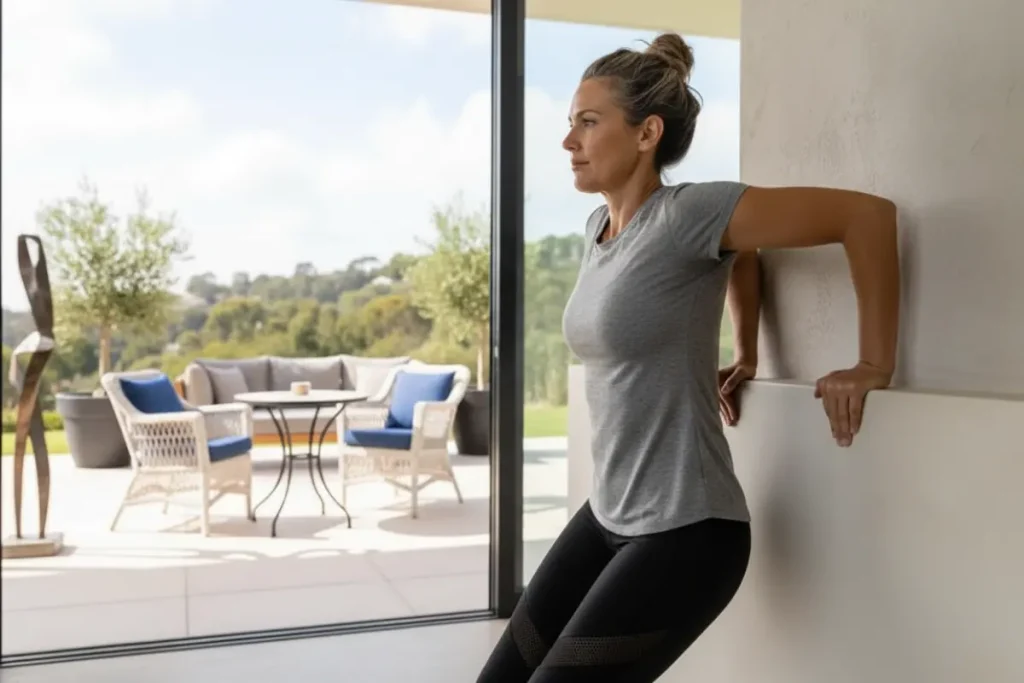

I remember standing in front of a set of dumbbells at my local gym, feeling completely out of place. I was 54, freshly into perimenopause, and convinced that how to start strength training after 50 was something other women, younger women, or women who had always been athletic already understood.
What helped me was making the first step much smaller. I did not need to know every exercise or lift the heaviest weight in the room. I needed a few movements I could control, enough resistance to practice with, and permission to learn gradually.
If you are completely new, this guide is about that first stage: what to do before your first workout, what equipment you actually need, how to choose beginner movements, how to judge effort, and when to progress. For the broader picture of resistance exercise, benefits, safety, and long-term progression, start with our complete strength training guide for women over 50.
Before your first strength workout
Before choosing exercises, think about your actual starting point. Have you been active recently? Do you have joint pain, balance problems, a recent injury or surgery, osteoporosis with fracture concerns, chest symptoms, dizziness, or another condition that could affect exercise? Your answers can change what a sensible first session looks like.
Being over 50 does not automatically mean you need medical clearance to move your body. But if you have significant symptoms, an unstable medical condition, a recent procedure or fracture, repeated falls, or uncertainty about what is safe for you, getting individualized guidance from a healthcare professional or physical therapist is more useful than following a generic online plan.
What equipment do beginners actually need?
You can begin with very little. Body weight, a sturdy chair, a wall, a resistance band, or a pair of manageable dumbbells can all provide resistance. A gym can give you more options, but it is not a requirement.
The best beginner equipment is the equipment that lets you perform a movement with control. A weight that is appropriate for a row may be wrong for a shoulder exercise, so there is no single “women over 50” dumbbell weight that works for everyone.

Choose a few beginner movement patterns
When learning how to start strength training after 50, you do not need a long exercise list. A beginner session can introduce a few basic movement patterns and give you time to learn them.
- Sit-to-stand or supported squat: practices a movement used every day and can be adjusted with chair height and range of motion.
- Wall or elevated push-up: provides an adjustable upper-body pushing movement.
- Band or supported row: introduces an upper-body pulling movement.
- Hip-hinge or bridge variation: can introduce hip and posterior-chain work when the movement is appropriate for you.
- Supported calf raise or another simple lower-leg movement: can be practiced near a stable support if balance is a concern.
These are examples, not mandatory exercises. Pain, mobility limitations, previous injuries, balance, and technique can all affect which variation is appropriate.
What should your first session look like?
Your first session is a learning session, not a test. Choose a small number of movements, use a manageable resistance or body-weight variation, and stop a set while you can still control the movement. The goal is to leave with a clearer sense of what feels appropriate, not to exhaust every muscle.
For example, you might practice a lower-body movement, an upper-body push, an upper-body pull, and a hip-focused movement. Keep the setup simple enough that you can pay attention to technique and how your body responds.
Once you are comfortable with the basics and want a structured routine rather than a first-session framework, use our full-body workout for women over 50.
A simple first-session note you can reuse
Before you begin, write down your chosen movements and the support or resistance you will use. Afterward, note which versions felt controlled, what needed adjusting, and whether you would repeat the same session. This creates a useful starting record without turning your first workout into a test. Keep the next session familiar before adding new exercises.
How hard should beginner strength training feel?
A beginner set should feel like work without turning into a struggle for every repetition. If you cannot control the movement, hold your position, or maintain a comfortable range of motion, reduce the resistance or use an easier variation.
You do not need to train to complete muscular failure to make a beginner workout worthwhile. Early on, learning technique and finding a repeatable level of challenge can be more useful than chasing maximum intensity.
How often should you start?
General physical-activity guidance for adults includes muscle-strengthening activity on at least two days per week. That does not mean every beginner must immediately follow the same schedule. Your recent activity, health, exercise selection, recovery, and the difficulty of each session all matter.
If you are new or returning after a long break, a schedule that gives you time to learn and recover is more useful than trying to do as much as possible in the first week. Consistency grows from a routine you can repeat.
How to progress without rushing
Progress does not only mean lifting a heavier dumbbell. You can improve your technique, increase a comfortable range of motion, add a repetition, use a little more resistance, add a set, or progress to a more challenging exercise variation.
Change one thing at a time and pay attention to how you recover. If your form becomes noticeably worse or pain and unusual fatigue are increasing, that is not a signal to keep adding load.
What if you have joint pain or arthritis?
Joint pain does not have one universal exercise solution. Some people can strength train comfortably with changes to range of motion, resistance, position, or exercise selection. Others need assessment before progressing.
Do not use pain as proof that an exercise is “working.” Persistent or worsening pain, significant swelling, instability, pain after an injury, or symptoms that interfere with everyday movement deserve appropriate evaluation.
Recovery is part of your beginner plan
It is normal for an unfamiliar workout to feel different from your usual activity, and some temporary muscle soreness can occur. But soreness is not a requirement for progress. Sleep, adequate food, hydration, rest, and sensible progression all contribute to recovery.
Recovery concerns deserve attention, not an automatic supplement recommendation. For a personal perspective rather than a medical guide, you can read this recovery story featuring a supplement. This is promotional content, not a treatment recommendation.
Do beginners need to change their diet?
You do not need a complicated supplement stack or a restrictive diet to earn the right to strength train. Adequate food and protein matter for muscle and recovery, but individual needs vary with body size, activity, overall diet, health conditions, and goals.
If you want to understand that part without turning your first workout into a nutrition project, see our guide to protein intake for maintaining muscle after 50.

Common beginner mistakes to avoid
- Doing too much too soon: more exercises, more weight, and more sessions at the same time can make it difficult to judge what your body is tolerating.
- Copying someone else’s weights: resistance should fit the exercise and your current ability.
- Using soreness as a score: a successful workout does not have to make you sore the next day.
- Ignoring technique to finish a set: reduce the resistance or change the variation if control is breaking down.
- Changing everything at once: small, trackable adjustments make progression easier to understand.
Your next step
If you have been wondering how to start strength training after 50, keep the first goal practical: learn a few movements, find resistance you can control, repeat them consistently, and progress one step at a time. You do not need to prove anything in your first week.
That was the shift that helped me most. Strength stopped feeling like something I should already know how to do and became something I could learn. Once the basics feel familiar, you can build from there.
Frequently asked questions
Is it safe to start strength training at 55 or 60 with no experience?
Many adults can begin resistance exercise later in life, but the right starting point depends on health, symptoms, mobility, balance, recent injuries or procedures, and current activity. If you have significant medical or musculoskeletal concerns, get individualized guidance before progressing on your own.
How often should a beginner over 50 strength train?
General adult activity guidance includes muscle-strengthening exercise on at least two days per week, but beginners may need to build toward a schedule that fits their health, recovery, and starting ability. The goal is a routine you can perform consistently with good control.
Do I need heavy weights to start strength training after 50?
No. Beginners can use body weight, bands, dumbbells, machines, or other resistance. Choose a level that feels challenging enough to practice the movement while still allowing controlled technique.
What if I have joint pain or arthritis?
Joint symptoms may require changes to the exercise, resistance, position, or range of motion. Persistent, worsening, severe, or unexplained pain should be assessed rather than treated as something you simply need to push through.
Do I need supplements before I start strength training?
Not necessarily. A balanced eating pattern can provide protein and other nutrients, while supplement needs depend on the individual. If you have a deficiency, restrictive diet, medical condition, or specific concern, discuss it with an appropriate healthcare professional.
The bottom line
Starting strength training after 50 does not require an extreme program. Begin from your actual ability, choose movements you can control, allow time to recover, and make progression gradual. If something feels wrong rather than simply challenging, adjust the plan and get appropriate help when needed.