

Last Tuesday, a woman sat across from me and said something that stayed with me for days. She’d been searching online for how to lose 50 pounds in 3 months, reading meal plans and workout routines. She told me she knew exactly what to eat and what to avoid, but the moment she felt stressed or alone, she’d find herself standing in front of the open fridge. She wasn’t lacking willpower or information. She was lacking kindness toward herself.
If you’re searching for how to lose 50 pounds in 3 months, we need to talk about something most weight loss articles completely ignore: the connection between your emotions and your plate. At this age, eating isn’t just about calories or macros. It’s about comfort, loneliness, exhaustion, and sometimes nostalgia. This article will show you why addressing emotional eating is more powerful than any aggressive diet plan
the reality about losing 50 pounds in 3 months
To be honest with you. Losing 50 pounds in 3 months is technically possible, but it requires a daily calorie deficit of nearly 2,000 calories, which health professionals don’t recommend. Most experts suggest losing 1 to 2 pounds per week, which means 12 to 24 pounds over 3 months is realistic and sustainable.
For 50 pounds, you’re looking at 6 to 12 months with healthy methods. I know that’s not what you wanted to hear. But here’s what matters more: understanding why every diet you’ve tried has failed. Because if you don’t address the emotional reasons you eat, even the most perfect meal plan won’t work.
So many women tell me they never struggled with this at 40. They ate normally, maintained their weight easily, and then something shifted. Menopause arrived. Retirement happened. Family dynamics changed. Suddenly, evening chocolate, bread, cheese, or wine became regular companions.
why emotional eating sabotages every weight loss plan
After 60, you’re often navigating several transitions at once. Your children have left home or are living their own lives. Your work changes, slows down, or stops completely. Your body transforms in ways that sometimes bring pain or limitations. Sometimes you lose someone close.
During these moments, food does what it’s always done beautifully: it soothes, occupies, and numbs. This isn’t a weakness. It’s a coping strategy your brain learned to protect you. The problem isn’t that you eat for comfort. The problem is when it becomes your only source of comfort.
Research shows that decreased emotional eating is directly associated with greater weight loss success. The odds of losing weight successfully are 1.70 times higher for people who reduce emotional eating compared to those who don’t. This isn’t about having more willpower. It’s about having more tools.
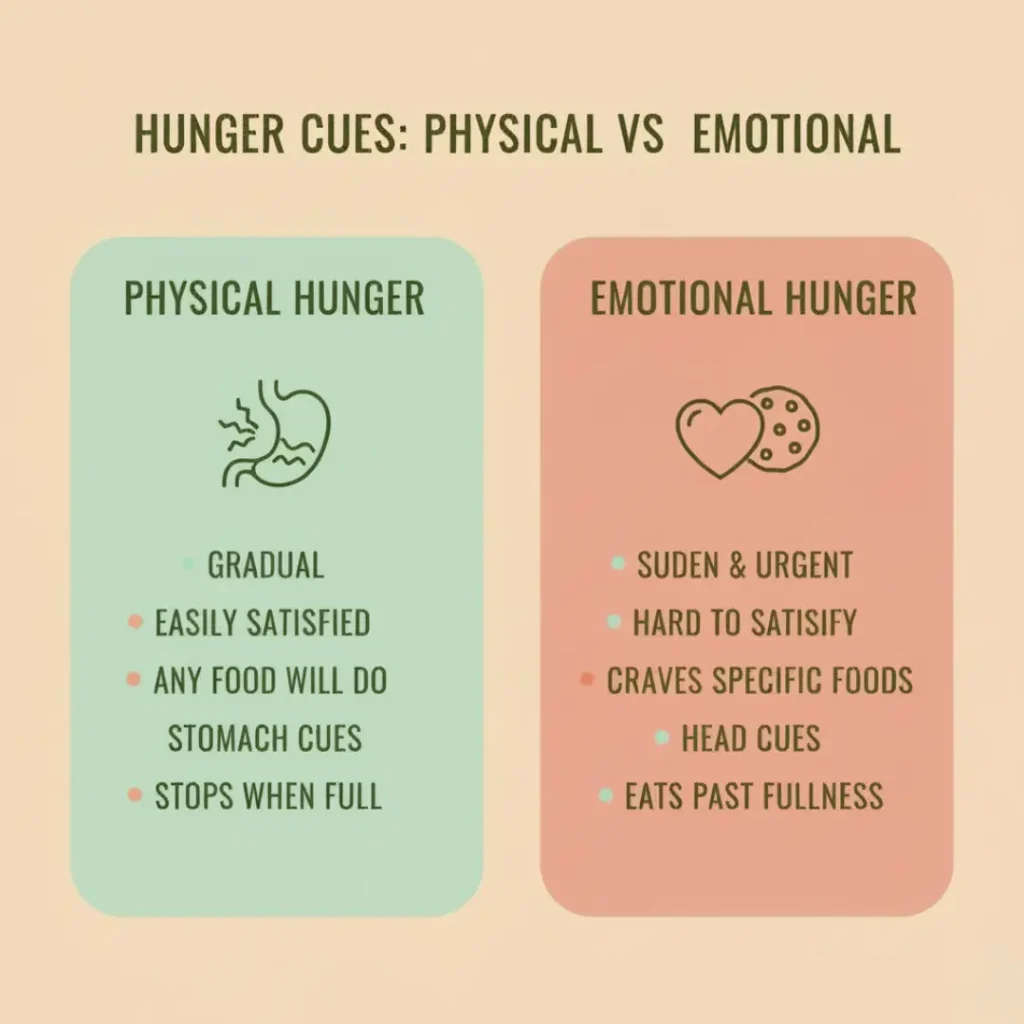
recognizing the difference between physical and emotional hunger
Before changing anything, you need to observe. A simple question I ask is this: Am I hungry in my stomach or in my head?
Physical hunger builds gradually. It can be satisfied by a real meal or simple, balanced food. It appears several hours after your last meal and comes with body signals like emptiness in your belly, dropping energy, and maybe slight shakiness.
Emotional hunger arrives suddenly. It pushes you toward a specific food—something sweet, salty, fatty, or comforting. It’s not necessarily related to when you last ate. And it doesn’t really disappear even after you’ve eaten.
Try tracking these simple elements for a few days: the time of day, what you were feeling, what you ate, and how you felt afterward. Was it soothing, guilty, heavy, neutral?
The goal isn’t creating a perfect chart. It’s seeing yourself with honesty and gentleness. This awareness alone can shift patterns that have felt completely automatic for years.
the emotions most often hidden behind the fridge
After 60, certain emotions surface particularly often when women talk to me about their eating patterns.
Silent Loneliness
You can be surrounded by people and feel profoundly alone. Evening arrives, the house grows quiet, and you hear the hum of the fridge, the television murmurs in the background. The urge to snack keeps company with that silence.
Many women say this is the hardest emotion to name because it feels ungrateful when you have a family who loves you. But emotional loneliness is real and doesn’t judge your circumstances.
Stress and Worry About Others
You worry about your children, your grandchildren, your partner, your aging parents. You carry so much, often silently. Food becomes a pause, a mental break from the constant weight of caring.
This isn’t selfish; it’s human. But the chocolate bar can’t actually solve what’s weighing on your heart, even though it tries.
Nostalgia and Loss
Certain foods connect to happy memories—a dessert your mother made, a family dish, a childhood treat. When you’re missing someone or something, your brain naturally reaches for these anchors.
Food becomes a time machine, trying to bring back what you’ve lost. It’s beautiful and painful at the same time.
Deep Exhaustion
Not just physical tiredness, but the weariness of always managing, deciding, adapting. When you’re completely drained, you don’t have energy to prepare a balanced meal. You grab what’s there, what’s quick, what delivers an immediate shot of pleasure.
When you’re completely drained and managing menopause fatigue, you don’t have energy to prepare a balanced meal, so you grab what’s quick and delivers an immediate shot of pleasure.
Also, Identifying the emotion doesn’t solve everything. But it’s the first step toward stopping the thought “I have no willpower” and starting the thought “I understand why I do this.”
creating comfort rituals that don’t involve food
The goal isn’t eliminating all emotional eating; that’s unrealistic. The goal is to dilute its importance by adding other forms of comfort.
Many women find these simple rituals helpful:
The Evening Tea Ritual
Instead of snacking in front of the television, prepare yourself a beautiful cup of herbal tea. Sit in your favorite chair and give yourself 10 minutes of real presence, no phone, no news. Just you, the warmth of the cup, the steam, the scent, the quiet.
The unload your thoughts notebook
Before opening the cupboard, take three minutes to write everything you’re feeling. It doesn’t need to be pretty or well-worded. Just “I’m angry,” or “I’m scared,” or “I’m exhausted.” Putting words on paper often releases enough pressure that the urge to eat diminishes.
The heart-to-heart phone call
Having a friend, sister, or cousin you can tell “right now I just want to raid the fridge” changes everything. Human connection soothes things that chocolate can never truly heal.
the mini movement break
When the urge to eat arrives suddenly, allow yourself three minutes of movement before any decision. Walk around your living room, stretch your back, take a few deep breaths. You can always eat afterward if you still want to. Often, the intensity drops a bit with movement.
These simple daily habits work together to create a foundation of self-care that naturally reduces emotional eating. What matters isn’t perfection; it’s having multiple tools in your toolkit instead of relying on food alone.
keeping the pleasure of eating without losing control

keeping the pleasure of eating without losing control
You don’t have to choose between forbidding everything and letting everything go. There’s a middle space, more nuanced, more adult, where you can be both responsible and kind to yourself. A few simple principles can help.
plan pleasure intentionally
Instead of automatically eating chocolate every evening, you might decide that two evenings a week, I’ll truly savor a dessert I love. When pleasure is planned, it stops hiding in guilt. You can look forward to it, enjoy it fully, and move on.
Starting your day with nutrient-rich breakfast choices helps stabilize blood sugar and reduces afternoon emotional eating
eat sitting down without distraction
Even for a small piece of cake or cheese, sit down and use a plate. Take a few breaths. You’ll be amazed at how the amount you truly need decreases when your presence increases. This simple act transforms eating from unconscious to conscious.
check your hunger level before and after
Before eating, ask yourself on a scale of 0 to 10: How hungry am I? After eating, ask again: And now? This helps reconnect your mind to your body, bridging the gap that emotional eating creates.
avoid all-or-nothing thinking
If you ate more than you planned, the solution isn’t “tomorrow I’ll eat almost nothing.” That creates a punishment cycle that fuels more emotional eating. The solution is returning to your normal habits as quickly as possible, without drama or punishment talk.
when weight loss becomes gentler because you speak to yourself differently
What I’ve noticed again and again with women over 60 is that how they talk to themselves weighs more heavily than what’s on their plate.
Phrases like “I’m worthless,” or “At my age, it’s hopeless,” or “I’ve ruined everything today, so what’s the point?” create stress and shame. And you can guess what follows: even more emotional eating.
Try a much more powerful approach. Speak to yourself as you would speak to your best friend. For example: “Okay, today I ate more than I planned. What was I really trying to soothe or avoid?” or “I’m going through a difficult time, so naturally this is harder” or “I can make a kinder choice for myself at the next meal. I don’t need to wait until Monday.”
When your inner voice becomes more ally than judge, the need to take refuge in food naturally diminishes. This shift in self-talk is often what finally allows women to lose weight without fighting their body, whether it takes 3 months, 6 months, or a year.
if you’re serious about losing 50 pounds
If losing 50 pounds is your genuine goal, here’s what the research supports for sustainable results:
set a 6-12 month timeline
Losing 50 pounds safely requires 6 months to a year. This allows your body to adjust, preserves muscle mass, and gives you time to build new habits that last beyond the initial weight loss.
aim for a moderate calorie deficit
Reduce your intake by 500 to 1,000 calories daily through a combination of eating less and moving more. This produces 1 to 2 pounds of loss weekly without triggering extreme hunger or metabolic slowdown.
address the emotional eating first
All the meal plans in the world won’t work if you’re still using food to manage stress, loneliness, or exhaustion. Working with a therapist who specializes in eating behaviors, building alternative coping strategies, and developing self-compassion creates the foundation for lasting weight loss.
Frequently Asked Questions
Emotional eating after 60 isn’t a character failure. It’s often a sign that you’re carrying a lot, navigating changes, and your body is reaching for quick solutions to soothe you.
Learning to soothe your heart in ways beyond food doesn’t mean giving up the pleasure of eating. It means expanding your options, giving yourself more freedom, and creating more peace. This makes weight loss gentler, more stable, and more aligned with how you want to live this new phase of your life. Always speak with your healthcare provider if you’re struggling significantly with eating patterns or emotional health.
Start with just one thing this week, choose one moment in your day when you’ll replace the eating reflex with another gesture of gentleness toward yourself. Notice what changes, even a little. What small act of self-kindness will you try this week? Share in the comments below.