
Last Tuesday, a woman sat across from me and said something that stayed with me for days. She’d been searching online for how to lose 50 pounds in 3 months, reading meal plans and workout routines. She told me she knew what she was “supposed” to eat, but stress and exhaustion kept pulling her back toward old patterns.
If you’re searching for how to lose 50 pounds in 3 months, the most useful place to start is not with a crash diet. It is with a realistic look at the timeline, your health, the habits you can sustain, and the reasons eating becomes harder during stressful seasons of life. For women over 50, medications, medical conditions, sleep, stress, hormones, activity level, and changes in muscle mass can all influence weight management.
Can you safely lose 50 pounds in 3 months?
Fifty pounds in roughly 12 to 13 weeks is a very aggressive target for many people. I would not build a do-it-yourself plan around forcing that number by a deadline. The CDC notes that people who lose weight gradually and steadily, around 1 to 2 pounds per week, are more likely to keep it off than people who lose weight more quickly. Your appropriate pace may be different, especially if you have a medical condition, take medications that affect weight, or are considering a large amount of weight loss.
Instead of asking only, “How fast can I lose 50 pounds?” ask, “What pace and plan make sense for my body and health?” NIDDK advises working with a health professional to set an appropriate goal and time frame and gives 5% of starting body weight over six months as one example of an initial goal. That is very different from promising every woman the same number of pounds on the same schedule.
If menopause is part of the picture, our guide to losing weight during menopause looks more specifically at that stage of life.
Why weight loss can feel different after 50
Weight management is not simply a test of willpower. Age, health conditions, medicines, stress, sleep, activity, food environment, and hormonal changes can all matter. That is one reason a rigid online calorie target may fit one person poorly and another person even worse.
For women who want a broader, age-specific starting point, I would use our weight loss after 60 guide rather than chasing an extreme deadline.
The emotional side of losing a large amount of weight
This is the part I do not want to lose from the conversation. A perfectly organized eating plan can still become difficult when food is also serving as comfort, distraction, reward, or relief.
After 50 or 60, life can bring several transitions at once. Work changes. Family roles shift. Sleep may become less predictable. You may be caring for other people while trying to care for yourself. Grief, loneliness, stress, and exhaustion can all change how you eat.
That does not mean every craving is “emotional eating,” and it does not mean emotional eating is the sole reason someone has difficulty losing weight. It simply means your eating pattern deserves the same attention as the numbers on the scale.
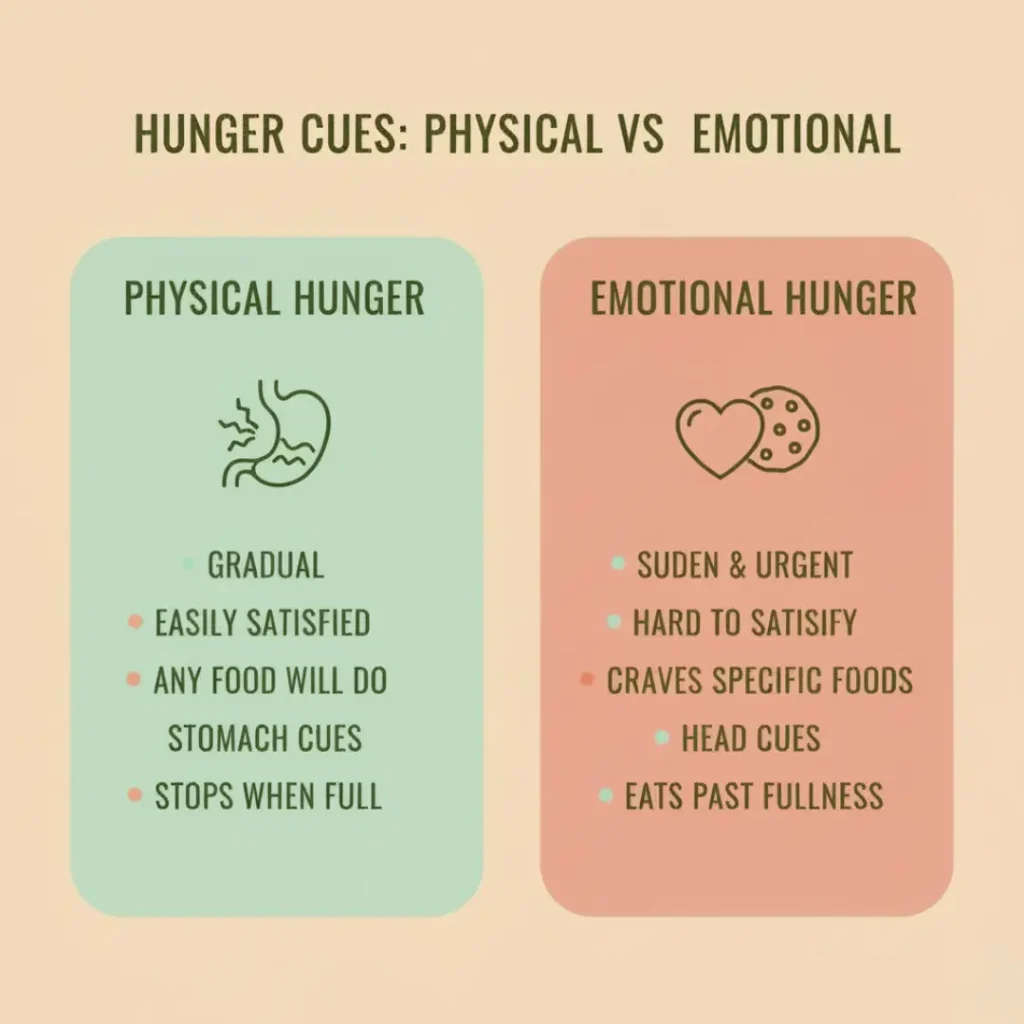
Physical hunger versus emotional hunger
Before changing anything, observe what happens around the moments when eating feels hardest. Physical hunger often develops gradually and may be satisfied by a range of foods. An emotionally driven urge can feel more sudden or tied to a particular comfort food, situation, or feeling. Real life is not always this tidy, so treat these patterns as clues rather than a diagnostic test.
For a few days, you might simply notice the time, how hungry you felt, what was happening around you, what you ate, and how you felt afterward. The goal is not to create another rulebook. It is to make an automatic pattern easier to see.
What may be hiding behind the trip to the fridge
Loneliness. Evening arrives, the house grows quiet, and snacking fills a space that food cannot really replace.
Stress and worry. Caring about children, grandchildren, a partner, aging parents, finances, or health can make food feel like an easy pause from a busy mind.
Nostalgia and loss. Food is deeply connected with memory. A familiar dish can bring comfort when you miss a person, a place, or an earlier stage of life.
Exhaustion. When you are depleted, planning and preparing food can feel harder. If fatigue has become a recurring part of menopause for you, our guide to menopause fatigue explores that issue separately.
Build comfort rituals that do not depend only on food
The goal is not to ban comfort eating forever. It is to give yourself more than one way to respond when you are stressed, bored, lonely, or exhausted.
You might make tea and sit somewhere away from the kitchen, write down what is occupying your mind, call someone you trust, or take a short walk if movement is appropriate for you. These are not weight-loss tricks. They are alternatives that create a little space between an emotion and an automatic response.

What a more realistic weight-loss plan includes
A sustainable plan is usually less dramatic than the plans that promise the fastest transformation. It should be tailored to your starting point, health, preferences, and ability to maintain it.
Start with an individualized goal. If you want to lose a substantial amount of weight, especially after 50, discuss the goal and time frame with a qualified health professional rather than using a generic online deadline.
Choose an eating pattern you can maintain. NIDDK describes successful programs as including a healthy reduced-calorie eating pattern tailored to the person’s needs and preferences. That is more useful than prescribing the same calorie deficit to every reader.
Include activity that fits your health and ability. Physical activity supports health and long-term weight management, but the appropriate type and amount depend on the individual. If you have pain, mobility limitations, cardiovascular concerns, or have been inactive for a long time, get appropriate medical guidance before making a major change.
Pay attention to sleep and stress. Healthy weight management is not only about food. The CDC includes sleep and stress management alongside healthy eating and physical activity in its guidance on healthy weight loss.
Get support when eating feels difficult to control. If you regularly binge, feel out of control around food, compensate after eating, or experience significant distress about food or body weight, speak with a qualified health professional. That deserves appropriate care, not another restrictive diet.
What about GLP-1 medications or weight-loss procedures?
Prescription weight-management medications and bariatric or metabolic procedures can be appropriate for some people, but they are medical treatments, not shortcuts to reproduce from an online article. Eligibility, benefits, risks, side effects, other medications, medical history, and long-term follow-up all matter.
NIDDK notes that the amount of weight lost with prescription weight-management medication varies by medication and by person, and that choosing a medication should be a decision made with a health professional. I would not use someone else’s Ozempic or GLP-1 result as a prediction for your own body.
So, how long might losing 50 pounds take?
There is no single responsible timeline that applies to every woman. The CDC’s commonly cited gradual pace of about 1 to 2 pounds per week provides useful context, but weight loss is rarely perfectly linear and individual medical circumstances can change the plan. If your goal is 50 pounds, think in terms of a longer-term health project rather than a 90-day race.
The better goal is not to make the scale move as fast as possible. It is to improve your health while protecting nutrition, strength, function, and your relationship with food.
Frequently Asked Questions
The bottom line
If you arrived here searching for how to lose 50 pounds in 3 months, I understand the desire for a clear deadline. But your health deserves more than a race against the calendar. A large weight-loss goal is better approached with an individualized time frame, sustainable eating and activity habits, attention to sleep and stress, and professional support when needed.
Emotional eating can be part of that picture without becoming a reason to blame yourself. Learn the pattern, build other forms of comfort, and focus on changes you can continue long after three months have passed.
For broader Lonage guidance, explore our weight loss, blood sugar and metabolism after 50 hub.