

Protein intake for muscle mass after 50 matters because aging changes how efficiently muscle responds to dietary protein and exercise. But there is no single perfect protein number for every woman. Body size, activity level, total energy intake, health conditions, appetite, and whether you do resistance training all affect what is appropriate.
The practical goal is not to chase the highest possible intake. It is to get enough high-quality protein across the day while keeping the rest of your diet balanced. For the broader food framework around protein, plants, carbohydrates, fats, and key nutrients, start with our what to eat after 50 guide.
Why Protein Becomes More Important for Muscle After 50
Muscle is constantly being broken down and rebuilt. With age, the muscle-building response to a meal can become less sensitive, a phenomenon often described as anabolic resistance. That does not mean your body stops responding to protein. It means adequate protein becomes especially important alongside resistance exercise and enough overall food.
Menopause can add another layer. Changes in hormones, activity, sleep, body composition, and recovery may all influence muscle health. Protein helps provide amino acids for muscle tissue, but it works best as part of a broader plan that includes progressive resistance training, adequate energy intake, recovery, and management of medical conditions that may affect strength or appetite.
How Much Protein Do Women Over 50 Need?
The standard adult protein reference intake is commonly expressed relative to body weight, but some expert groups and research on healthy older adults support intakes above the minimum reference level to help preserve muscle and function. A frequently discussed range for healthy older adults is around 1.0 to 1.2 grams of protein per kilogram of body weight per day, with individual needs varying.
0.8 g/kg vs. 1.0–1.2 g/kg: What Is the Difference?
The figure of 0.8 grams per kilogram per day is the standard adult Recommended Dietary Allowance in the United States. It is designed as a population-level reference amount that meets the needs of nearly all healthy adults, not as a personalized muscle-building target. In research and expert guidance focused on older adults, approximately 1.0 to 1.2 grams per kilogram per day is often discussed as a practical range for healthy older people, particularly when preserving muscle and physical function is the goal. These numbers should not be treated as competing rules: 0.8 g/kg is a general reference intake, while 1.0–1.2 g/kg is a higher range discussed in the context of healthy aging. Your appropriate intake can differ with age, activity, energy intake, illness, kidney function, and other health factors.
Protein Calculator Table by Body Weight
The table below shows what 1.0 and 1.2 grams of protein per kilogram look like at several common body weights. Use it as an educational estimate rather than an individualized prescription.
| Body Weight | At 1.0 g/kg | At 1.2 g/kg |
|---|---|---|
| 120 lb / 54 kg | ~54 g/day | ~65 g/day |
| 130 lb / 59 kg | ~59 g/day | ~71 g/day |
| 140 lb / 64 kg | ~64 g/day | ~77 g/day |
| 150 lb / 68 kg | ~68 g/day | ~82 g/day |
| 160 lb / 73 kg | ~73 g/day | ~88 g/day |
| 170 lb / 77 kg | ~77 g/day | ~92 g/day |
| 180 lb / 82 kg | ~82 g/day | ~98 g/day |
For example, a woman who weighs about 68 kilograms (150 pounds) would get roughly 68 to 82 grams per day within that range. This is an illustration, not a personal prescription. Someone who trains regularly may have different needs, while kidney disease, certain metabolic conditions, acute illness, unintended weight loss, or other medical issues can change what is appropriate.
If you have kidney disease or have been told to limit protein, do not increase your intake based on a general article. A clinician or registered dietitian who knows your medical history can help set an appropriate target.
Protein and Strength Training Work Together
Protein supplies building blocks, while resistance exercise provides a strong stimulus for maintaining and building muscle. Eating more protein without challenging the muscles is not equivalent to strength training, and strength training without adequate nutrition can also limit progress.
If you are new to resistance exercise, our strength training for women over 50 guide explains how to build a sustainable routine. The nutrition and fitness articles complement each other, but they answer different search intents: this page focuses on protein intake, while the strength guide focuses on training.
Should You Spread Protein Across the Day?
Many women find it easier to meet their needs when protein is included at breakfast, lunch, and dinner rather than leaving most of it for the evening. Research in older adults has also explored whether distributing meaningful amounts of protein across meals may support muscle protein synthesis.
There is no need to treat a fixed number of grams at every meal as a universal rule. A more useful approach is to look at your total daily intake first, then ask whether one or two meals are consistently very low in protein. Breakfast is often the easiest place to make a practical improvement.
For example, if your practical daily target is about 75 grams, you might reach it with roughly 20–25 grams at breakfast, 25–30 grams at lunch, and 25–30 grams at dinner. That is simply one workable pattern, not a rule that every meal must hit an exact number. A snack can also contribute when your meals are smaller or your appetite varies.
What About Protein After a Workout?

A protein-containing meal or snack after resistance exercise can support recovery and muscle protein synthesis. You do not need to panic about a tiny “anabolic window,” however. Total protein across the day, regular training, and consistency matter more than hitting an exact minute on the clock.
If workouts regularly leave you unusually exhausted, sore for longer than expected, or unable to progress, nutrition may be only one part of the issue. Our guide to slow recovery after exercise covers other factors worth considering.
Best Protein Foods After 50
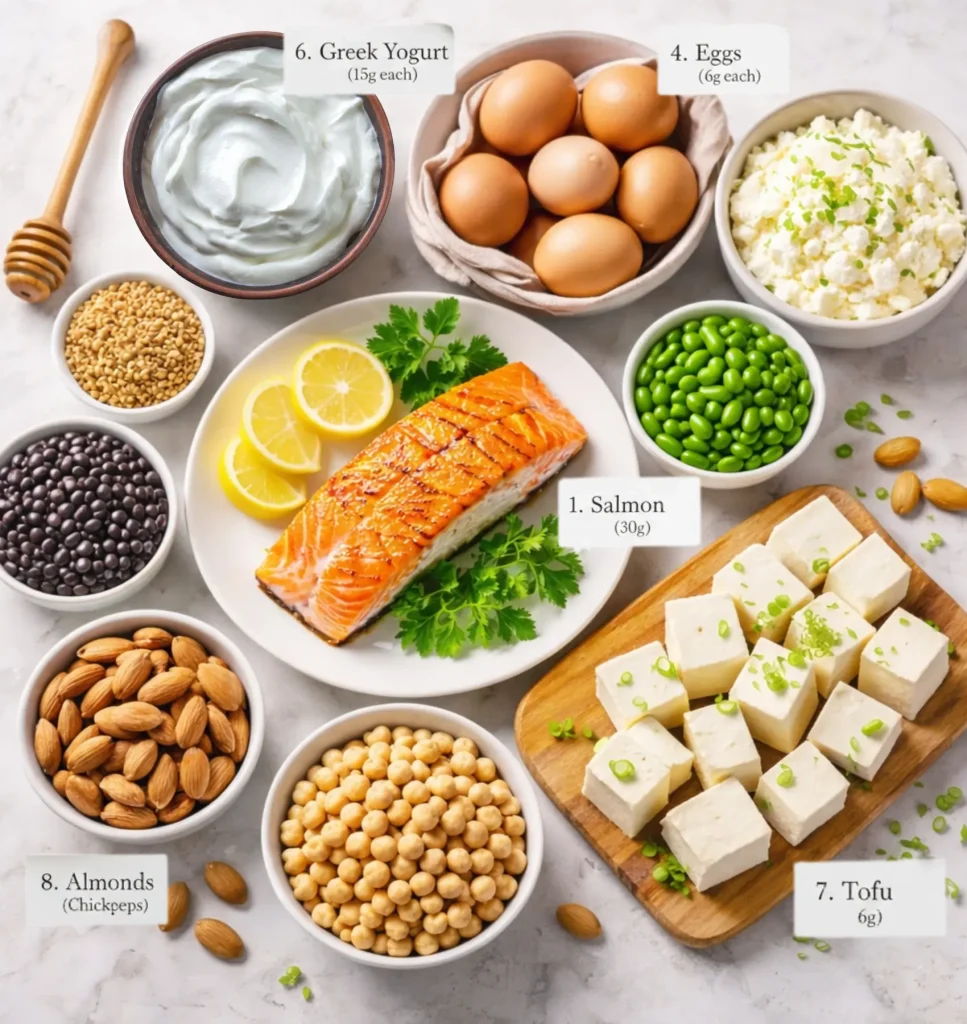
There is no single “best” protein food. The strongest pattern is one you can maintain and that also provides the nutrients you need. Useful options include fish, eggs, poultry, Greek yogurt, cottage cheese, milk or fortified alternatives, tofu, tempeh, beans, lentils, edamame, nuts, and seeds.
- Fish: provides protein, and fatty fish also supplies omega-3 fats.
- Greek yogurt and cottage cheese: convenient protein sources that can also contribute calcium.
- Eggs and poultry: versatile sources of complete protein.
- Soy foods: tofu, tempeh, and edamame provide high-quality plant protein.
- Beans and lentils: combine plant protein with fiber and other nutrients.
- Nuts and seeds: useful additions, although they are usually less protein-dense than foods such as dairy, soy, fish, or poultry.
Protein Sources at a Glance
Protein amounts vary by brand, cut, preparation, and serving size. These approximate values can help you see how different foods may fit into a day without turning every meal into a calculation.
| Protein Food | Typical Serving | Approx. Protein | Practical Use |
|---|---|---|---|
| Greek yogurt | 3/4 cup (about 170 g) | ~15–18 g | Breakfast or snack |
| Cottage cheese | 1/2 cup | ~12–14 g | Snack or meal addition |
| Eggs | 2 large | ~12–13 g | Breakfast or light meal |
| Cooked fish | 3 oz / 85 g | ~20–22 g | Lunch or dinner |
| Cooked chicken breast | 3 oz / 85 g | ~25–26 g | Lunch or dinner |
| Firm tofu | 1/2 cup | ~10–12 g | Plant-based meal |
| Tempeh | 1/2 cup | ~15–16 g | Plant-based meal |
| Cooked lentils | 1 cup | ~17–18 g | Soup, bowl, or side |
| Edamame | 1 cup cooked | ~18 g | Snack, bowl, or side |
These are estimates rather than fixed values. Check the nutrition label or a reliable food database when you need a more precise number for the exact product and portion you eat.
Do You Need Protein Powder?
No. Protein powder is a convenience, not a requirement. Food can meet protein needs for many women. A powder may be useful when appetite is low, meals are rushed, or getting enough protein from food is difficult.
If you use one, check the serving size, protein amount, added sugars, sodium, allergens, and other added ingredients. Supplements can vary in quality, and a product that is appropriate for one person may not be appropriate for another.
A Simple Protein Check for Your Day
| Meal | Question to Ask | Simple Options |
|---|---|---|
| Breakfast | Is there a meaningful protein source here? | Eggs, Greek yogurt, cottage cheese, tofu, or a protein-fortified meal |
| Lunch | Is protein more than a small garnish? | Fish, poultry, beans, lentils, tofu, tempeh, or dairy |
| Dinner | Is the meal balanced rather than protein-only? | Protein food plus vegetables, a quality carbohydrate, and healthy fat |
| Snacks | Would protein make this snack more satisfying? | Yogurt, milk, edamame, nuts, hummus, or another suitable option |
What If Your Appetite Is Lower?
Low appetite can make adequate nutrition harder. Smaller meals, protein-rich snacks, yogurt, eggs, soups with beans or lentils, or a suitable smoothie may be easier than forcing very large meals. Persistent loss of appetite, unexplained weight loss, swallowing difficulty, or ongoing digestive symptoms deserve medical evaluation rather than simply adding more protein powder.
Frequently Asked Questions
How much protein should a woman over 50 eat to support muscle?
There is no single target for everyone. A commonly discussed range for healthy older adults is around 1.0 to 1.2 grams per kilogram of body weight per day, but activity level, total food intake, health conditions, and individual goals can change what is appropriate.
Is protein more important after 50?
Protein remains important throughout adulthood, but age-related changes in muscle and the muscle-building response to food make adequate protein especially relevant after 50. Resistance exercise, sufficient energy intake, and overall diet quality also matter.
Should I eat protein immediately after strength training?
A protein-containing meal or snack after training can support recovery, but you do not need to hit an exact minute. Total daily protein, regular resistance training, and consistency are more important than a narrow timing window.
Can women over 50 get enough protein from plant foods?
Yes. Soy foods, beans, lentils, peas, nuts, seeds, and other plant foods can contribute substantial protein. A varied diet and adequate total intake are important, and some women may find fortified foods or a suitable protein powder convenient.
Do I need protein powder after 50?
Not necessarily. Many women can meet their needs through food. Protein powder is mainly a convenient option when appetite, time, dietary preferences, or other practical factors make adequate intake difficult.
Can I eat more protein if I have kidney disease?
Do not substantially increase protein without individualized advice if you have kidney disease or have been told to limit protein. Your appropriate intake depends on kidney function, medical history, treatment plan, and guidance from your healthcare team.
The Bottom Line
Protein intake for muscle mass after 50 is important, but more is not automatically better. Aim for a sufficient amount that fits your body size, activity, health, and overall diet; include protein across the day; and pair good nutrition with regular resistance exercise. The most useful plan is one that supports strength without crowding out vegetables, fruit, fiber-rich carbohydrates, healthy fats, and other nutrients your body needs.