
One day, a woman shared a common concern with me: “I’m eating the same way I did five years ago, but now I’m gaining weight. What’s going on?” It is a frustrating experience, and it can make you wonder whether your metabolism has suddenly stopped cooperating.
Your metabolism does change with age, but the story is more nuanced than simply saying it “slows down” the moment you turn 60. Changes in muscle mass, daily movement, body composition, sleep, health conditions, medications, and the menopause transition can all influence how much energy your body uses and how your weight changes over time. Understanding metabolism changes after 60 can help you focus on the habits that matter instead of fighting your body.
What actually happens to your metabolism after 60
Let me start with the basics. Metabolism describes the processes your body uses to turn food and stored energy into the fuel needed for breathing, circulation, movement, tissue repair, and everything else that keeps you functioning.
One important part of the picture is body composition. Adults tend to lose muscle as they get older, especially when strength activity and adequate nutrition are missing. Because lean tissue contributes to daily energy expenditure, preserving muscle becomes increasingly important as the years pass.
Activity can change too. A little less walking here, more sitting there, or recovering more slowly from exercise may not feel dramatic from one day to the next, but those changes can add up over months and years.
This is why two women of the same age can have very different energy needs. Age matters, but so do height, body size, muscle mass, activity, health, medications, sleep, and eating patterns.
If weight management is part of what brought you here, my broader guide to weight loss after 60 puts these changes into a wider, practical context.
The menopause and metabolism connection
If you have gone through menopause, you may also have noticed changes in where your body carries fat, particularly around the abdomen. Menopause can influence body composition and fat distribution, while aging, activity, sleep, diet, genetics, and other health factors continue to matter at the same time.
That distinction matters because it is easy to blame every change on hormones. Sometimes menopause is part of the picture without being the entire explanation.
Hormone therapy should not be treated as a weight-loss or metabolism treatment. It may be appropriate for certain menopause symptoms depending on an individual woman’s medical history and risk-benefit profile, but that decision belongs in a conversation with a qualified healthcare professional.
Building and preserving muscle after 60
If there is one area I would give more attention after 60, it is muscle. Strength is not only about appearance. Maintaining muscle supports mobility, independence, physical function, and healthy aging.
You can still become stronger after 60. The right starting point depends on your current fitness, mobility, medical history, and experience. For a more focused introduction, see our guide to strength training for women over 50.
For some women, bodyweight movements are a comfortable place to begin. Others prefer resistance bands, machines, or dumbbells. What matters more than chasing a particular exercise trend is choosing a level you can perform safely and progress gradually.

Eating patterns that support healthy aging and metabolism
After 60, I would rather focus on the quality and consistency of your eating pattern than promise a special “metabolism-boosting” food. Your needs are individual, and eating too little in an attempt to force faster weight loss can make it harder to get enough protein and other essential nutrients.
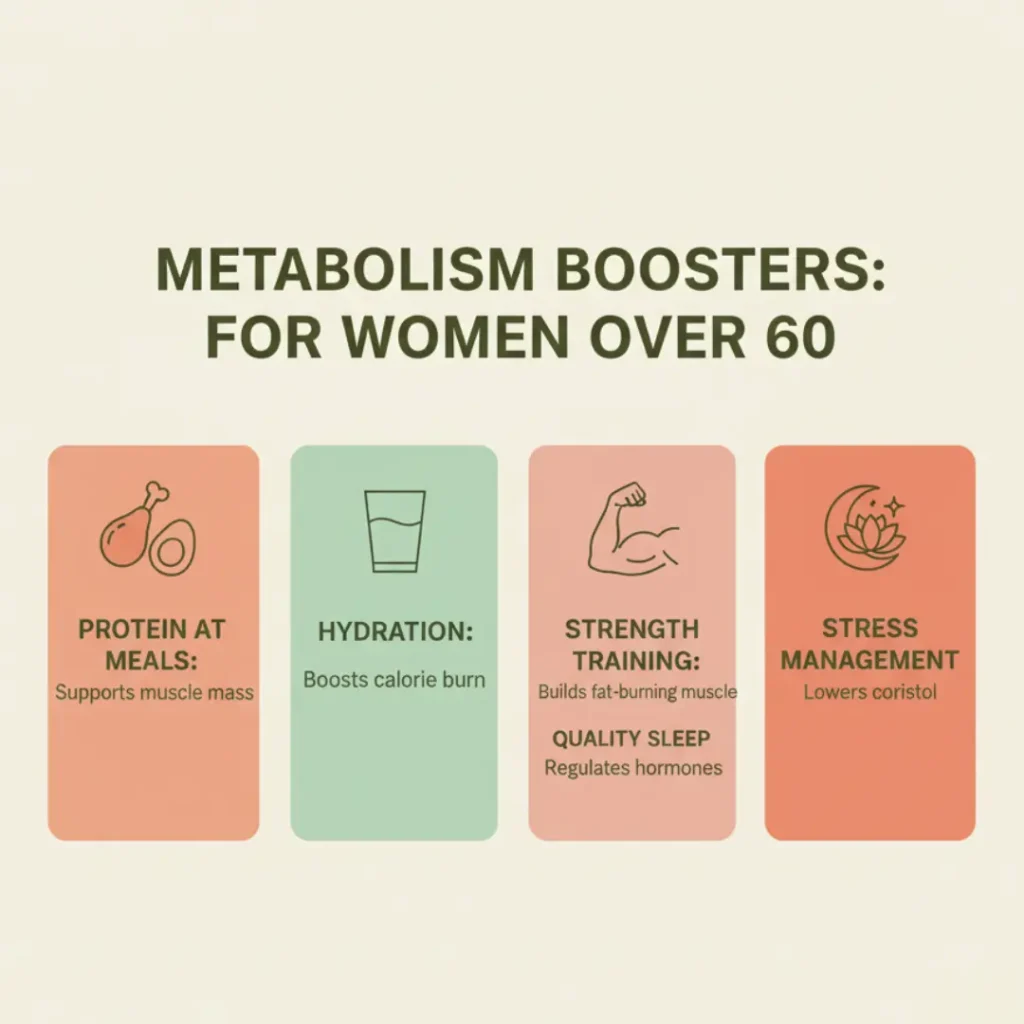
Make protein part of your meals
Protein helps maintain and repair muscle, which makes it especially relevant as you get older. Eggs, yogurt, fish, poultry, beans, lentils, tofu, and other protein-rich foods can all fit, depending on your preferences and health needs.
There is no single protein target that is right for every woman over 60. Your body size, activity, overall diet, kidney health, and medical circumstances can affect what is appropriate, so personalized advice is useful when you have a health condition or are making a major dietary change.
Choose nutrient-dense foods most of the time
Vegetables, fruit, whole grains, legumes, protein-rich foods, nuts, seeds, and unsaturated fats can help you build meals that provide nutrition without relying on extreme restriction.
A Mediterranean-style pattern is one example of a flexible way to organize these foods. You do not need to eat perfectly, and you do not need a rigid “metabolism diet” to support your health.
Be thoughtful about highly processed foods and added sugars
You do not have to ban dessert or carbohydrates. A more realistic approach is to make minimally processed, nutrient-dense foods the foundation of your usual meals while keeping room for foods you simply enjoy.
Stay hydrated
Hydration matters for normal body function and physical activity, but drinking extra water should not be sold as a way to dramatically speed up metabolism. Keep fluids accessible throughout the day and adjust your intake to your activity, climate, health, and medical guidance.
Movement strategies that support metabolic health
Exercise is useful for far more than the calories it burns. It supports cardiovascular health, strength, balance, mobility, and the ability to keep doing the things you enjoy.
Combine strength work with aerobic activity
Walking, cycling, swimming, dancing, and other aerobic activities can complement resistance training. The right amount and intensity depend on your current health and ability, particularly if you have been inactive or live with a condition that affects exercise.
Do not underestimate everyday movement
Structured workouts are only one part of an active day. Walking while running errands, gardening, taking the stairs when appropriate, standing up regularly, or moving around the house all contribute to your overall activity.
I like this approach because it shifts the question from “How do I burn the most calories?” to “How can I build more movement into a life I can actually maintain?”
Sleep, stress, and the bigger metabolic picture
Sleep and stress do not work like simple on-off switches for metabolism, but both can influence appetite, food choices, energy, recovery, and how easy it feels to stay active.
If poor sleep leaves you exhausted, you may naturally move less or reach for foods that feel convenient and comforting. Ongoing stress can affect eating patterns and make healthy routines harder to maintain. That is a more useful way to think about the connection than blaming a single hormone for abdominal fat.
Regular sleep routines, a comfortable bedroom, daytime movement, and practical stress-management habits can support the bigger picture. If fatigue, sleep disruption, or unexplained weight change is persistent, it is worth discussing with a healthcare professional rather than assuming your metabolism is simply “broken.”
When a metabolism change deserves a medical check
Not every weight or energy change after 60 is caused by aging. Thyroid problems, medication effects, sleep disorders, depression, diabetes and other conditions can affect weight, appetite, or energy. Seek medical advice if a change is unexplained, rapid, persistent, or accompanied by other symptoms that concern you.
Frequently asked questions
Why does metabolism change after 60?
Metabolism and energy needs can change with age for several reasons, including changes in muscle mass, body composition, physical activity and overall health. Menopause can also influence body composition and fat distribution, but it is only one part of the picture.
Can you boost your metabolism after 60?
There is no reliable shortcut that dramatically speeds up metabolism. Preserving muscle through appropriate strength training, staying physically active, eating a nutrient-dense diet, getting enough protein, sleeping well and addressing medical issues can support metabolic health as you age.
How many calories should a woman over 60 eat?
There is no single calorie number that fits every woman over 60. Energy needs vary with body size, muscle mass, activity, health and goals. A healthcare professional or registered dietitian can help estimate an appropriate intake when personalized guidance is needed.
Does hormone therapy speed up metabolism or cause weight loss?
Hormone therapy should not be used as a weight-loss or metabolism treatment. It may be appropriate for certain menopause symptoms depending on an individual’s medical history and risk-benefit profile. Decisions about hormone therapy should be made with a qualified healthcare professional.
Why am I gaining weight after 60 even though I eat the same way?
Several things may have changed even if your meals look similar, including muscle mass, daily movement, sleep, medications, health conditions and body composition. Persistent or unexplained weight change is worth discussing with a healthcare professional rather than assuming age is the only cause.
The bottom line
Metabolism changes after 60 are real, but they are not a sign that your body has failed you. Rather than chasing ways to “speed up” metabolism, focus on what you can influence: preserve muscle, keep moving, eat enough nourishing food, protect your sleep, and pay attention when your body is telling you something has changed.
Those habits may not sound as exciting as a metabolism hack, but they are far more useful for building strength, function, and health that can carry you through the years ahead.