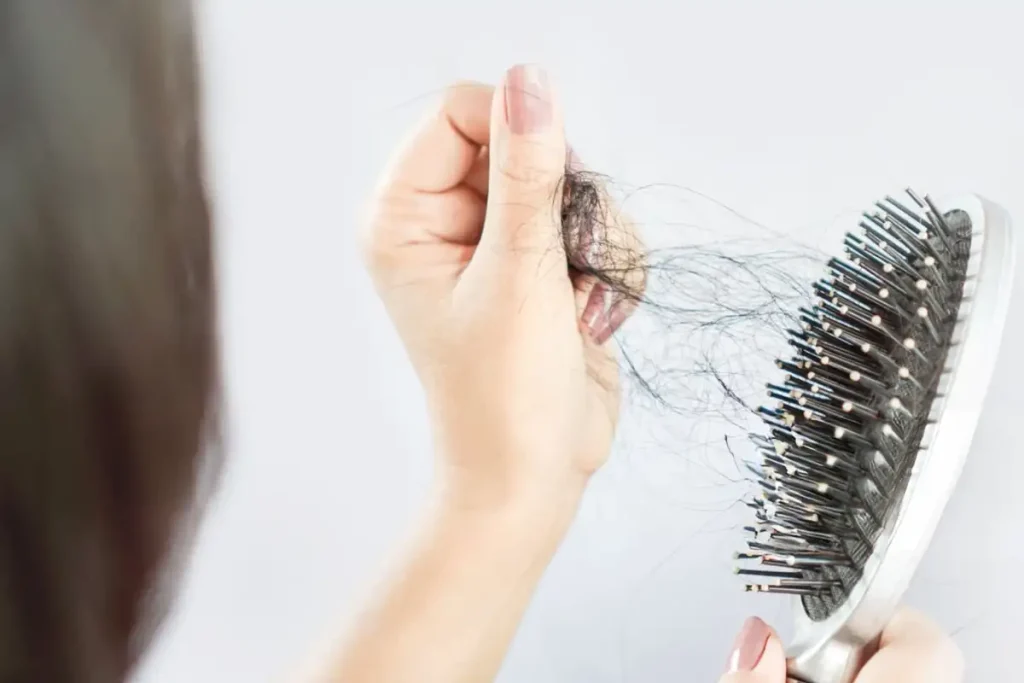

Hair that once felt flexible can become rough, dull, frizzy, or easy to snap during menopause. The useful question is not how to force every strand back to its earlier texture. It is how to reduce damage, improve softness, and distinguish dry hair from true loss of density.
This guide focuses on the hair fiber and daily care. If your part is widening, your ponytail is shrinking, or you are shedding full-length hairs, use our guide to thinning hair after menopause for the diagnosis and treatment pathway.
Why hair can feel drier during menopause
Sebum production and hair-fiber characteristics can change with age and hormonal transition. Gray hair may also behave differently, while years of coloring, bleaching, heat, sun, and mechanical wear accumulate along the length. These factors can leave the cuticle less smooth and the strand less able to hold moisture.
Dryness does not prove an estrogen, vitamin, iron, or biotin deficiency. It can coexist with scalp conditions, medication effects, thyroid disease, or nutritional problems, but those require history and assessment rather than a supplement guess.

First identify dryness, breakage, or shedding
| What you notice | Most likely problem to investigate | First response |
|---|---|---|
| Rough texture, tangles, frizz | Dry or weathered hair fiber | Condition, reduce heat, simplify chemical services |
| Short pieces and split ends | Breakage | Gentler detangling and less tension or bleach |
| Full-length hairs from the root | Shedding | Review triggers and use the Hair Hub |
| Itchy, red, painful, or heavily scaled scalp | Scalp disorder | Arrange professional assessment |
| Widening part or reduced density | Possible hair loss | Document and seek diagnosis |
A practical wash day routine
Clean the scalp gently
Choose a shampoo that cleans without leaving the scalp tight or irritated. There is no universal rule that menopausal hair should be washed every two or three days. Wash often enough to control oil, sweat, scale, and product buildup. Apply shampoo mainly to the scalp and let the lather move through the lengths.
Condition every wash
Apply conditioner from mid-lengths to ends and give it time to coat the hair. Detangle with fingers or a wide-tooth comb while the hair has slip. If the ends remain rough, add a small amount of leave-in conditioner before styling.
Use a weekly treatment only when it helps
A richer mask can reduce friction and improve softness, but more product is not always better. Heavy oils and butters may flatten fine hair or make buildup worse. Judge a treatment by manageability, not by promises to repair a strand permanently.
Reduce the damage that keeps dryness going
- Blot wet hair with a soft towel instead of rubbing it.
- Use the lowest effective heat and keep the dryer moving.
- Apply a heat protectant before hot tools and avoid repeated passes.
- Space bleaching, permanent color, relaxers, or overlapping chemical services.
- Rotate tight ponytails, clips, braids, and extensions so the same area is not under constant tension.
- Protect long hair from friction during sleep with a loose style and a smooth pillowcase if comfortable.

Choose products by function
| Need | Useful product feature | What to avoid |
|---|---|---|
| Cleansing | Comfortable scalp cleansing | Harsh scrubbing or fragranced products that irritate you |
| Slip | Conditioning agents that reduce friction | Detangling dry knots aggressively |
| Moisture feel | Leave-in conditioner or light cream | Layering many heavy oils on fine hair |
| Heat styling | Clearly labeled heat protectant | Very high heat on damp hair |
| Scalp symptoms | Diagnosis-based treatment | Essential oils or scrubs on an inflamed scalp |
Protein-containing products can make some damaged hair feel stronger temporarily, but too much may make other hair feel stiff. Alternate with a moisturizing conditioner and adjust based on how the hair responds.
Nutrition without supplement guessing
Adequate energy and protein support normal tissue maintenance. A varied diet can supply iron, zinc, essential fats, and vitamins, but dry texture alone cannot tell you what is missing. If you have restrictive eating, substantial weight change, fatigue, persistent shedding, a medical condition, or medication concerns, discuss them with a clinician.
Do not begin high-dose biotin, iron, vitamin D, zinc, or omega-3 solely for dryness. Biotin can interfere with some laboratory tests, iron can be harmful when unnecessary, and supplements may duplicate other products or interact with medicines.
When to get help
See a dermatologist or clinician for rapid density loss, bald patches, scalp pain or burning, pustules, thick scale, shiny scar-like areas, eyebrow loss, or symptoms that persist despite a simple routine. A stylist can help reduce fiber damage, but should not diagnose a medical cause.
If you are unsure whether fine texture, breakage, or density loss is driving the change, compare the signs in Fine Hair vs Thinning Hair Over 60.
Frequently asked questions
What is the best treatment for dry menopausal hair?
Start with regular conditioning, gentle detangling, lower heat, and less chemical overlap. The best products depend on strand thickness, damage, scalp comfort, and how easily the hair becomes weighed down.
How often should I wash dry hair after menopause?
There is no fixed schedule. Wash often enough to keep the scalp comfortable and clean. Adjust for oil, sweat, styling products, texture, and scalp conditions.
Can dry hair make my hair look thinner?
Yes. Breakage, frizz, and separated ends can reduce visual fullness. A widening part or increased root-level shedding needs a separate hair-loss assessment.
Should I take biotin or collagen for dry hair?
Dry texture does not diagnose a deficiency. Review supplements with a clinician if you have persistent shedding, dietary restrictions, medical conditions, or take medicines.
The bottom line
Learning how to treat dry hair during menopause begins with the fiber: clean the scalp, condition the lengths, reduce heat and chemical stress, and watch for breakage. Send shedding and density loss to the Hair Hub. For broader guidance, visit the Skin Care Guide for Women Over 50.