

I was standing at the top of a narrow stone staircase in Porto, Portugal, watching my daughter disappear around a sun-drenched corner.
The view was extraordinary. The tiles. The light. The smell of espresso drifts up from somewhere below.
And all I could think about was whether my right knee would forgive me by the time we reached the bottom.
I didn’t say anything. I just held the railing a little tighter and made a quiet promise to myself: I was not going to let stiffness steal the next chapter. I had too many staircases left to climb.
That promise is what started me on this journey, and I want to share everything I’ve learned about stiffness with you, the daily habits quietly working against my joints, and how I built a smarter routine, with Flexi Move Joint Capsules as one optional piece of the puzzle.
If you’ve been looking for a joint support option to complement your routine, Flexi Move Joint Capsules may be worth exploring.
The Problem I Didn’t Know I Had
The Problem I Kept Minimizing
Here’s what I didn’t fully understand until I started researching: the joint changes that happen after menopause are not simply wear and tear. They’re driven, at least in part, by hormonal shifts. Estrogen plays a direct role in maintaining cartilage, lubricating synovial membranes, and keeping connective tissue resilient. When estrogen drops after menopause, that protective function diminishes significantly.
A study published in PubMed (2016) found that postmenopausal women showed significantly more severe knee cartilage degeneration than premenopausal women, even after controlling for body weight, height, and age. A separate longitudinal study confirmed that healthy postmenopausal women lose between 1.5% and 3.2% of tibial cartilage volume every single year. A 2024 review on Physio-Pedia reported that 51–59% of women experience joint pain, stiffness, or backache as a menopausal symptom.
I was not imagining it. My joints were genuinely more vulnerable than they had been five years earlier. But the biology alone wasn’t the whole story. What I did on top of that biology made everything significantly worse.
The Mistakes I Made (And I Made All Five)
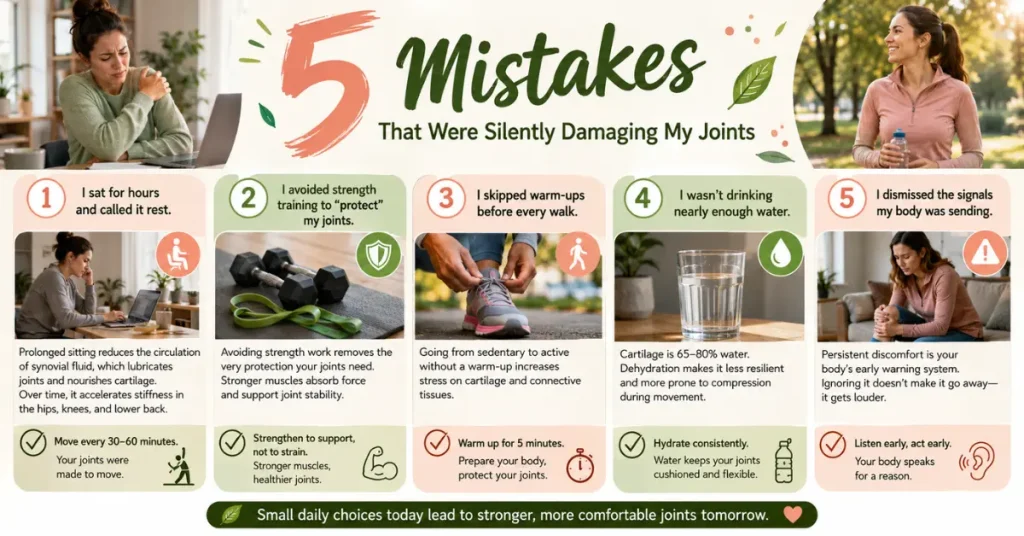
Mistake 1: I sat for hours and called it rest.
I work from home. I write, I research, I spend long stretches in front of a screen. I told myself that this was mentally demanding work and that my body needed stillness to compensate. What I didn’t understand is that joints are nourished through movement, not stillness. Synovial fluid, the liquid that lubricates cartilage, only circulates actively when you move. According to Eat This Not That (2023), citing an ACE-certified personal trainer, prolonged sitting directly reduces this lubrication cycle, accelerating stiffness in the hips, knees, and lower back over time. I was sitting for three, sometimes four hours at a stretch. My joints were quietly paying for it.
Mistake 2: I avoided strength training to “protect” my joints.
The logic felt sound at the time. My knees felt sensitive, so I stopped squatting, stopped using resistance bands, stopped anything that put load on the joint. This was exactly backwards. A 2022 study published in PubMed found that heavy resistance training significantly improved mobility and perceived quality of life in older women. The surrounding muscles are what absorb force before it reaches the joint. By avoiding strength work, I removed the very protection my joints needed most.
Mistake 3: I skipped warm-ups before every walk.
I would lace up my shoes and walk out the door cold. No five-minute gentle movement, no gradual increase in pace, nothing. Research published in Eat This Not That (2025) confirms that going directly from sedentary to active without a warm-up increases mechanical stress on cartilage and cold, less elastic connective tissue. I was doing this every single morning.
Mistake 4: I wasn’t drinking nearly enough water.
Cartilage is approximately 65–80% water, according to published biomechanics research. Chronic low-grade dehydration makes that cushioning tissue less resilient and more prone to compression stress during movement. I thought I was drinking enough. I wasn’t.
Mistake 5: I dismissed the signals my body was sending.
Brown Health (2021) notes that persistent joint discomfort is the body’s early warning system, a signal that something in the joint environment needs attention. I treated it as background noise for nearly two years. That delay cost me. The signal doesn’t go away on its own when you ignore it. It gets louder
The Consequences of Getting This Wrong
What I experienced over those two years was a slow narrowing of my daily life. Not dramatic, but steady. I started avoiding the steep hill on my favorite walking route. I stopped planning the hiking trips I used to love. I hesitated before accepting invitations that involved a lot of walking or standing.
Mass General Brigham (2026) confirms exactly this pattern: inactivity worsens joint pain, which leads to more inactivity, which accelerates the discomfort further. I was caught in that loop without recognising it. And the hardest part wasn’t the physical limitation. It was watching my world quietly shrink.
The Solution That Actually Changed Things
When I finally stopped guessing and started applying what the research actually said, the shift was real. Not overnight, but measurable within weeks.
I started standing up and moving every 40 minutes during my workday. I reintroduced resistance training, twice a week, with light dumbbells and resistance bands. A randomized controlled trial in PubMed (2021) found that 12 weeks of this type of training improved dynamic balance scores by approximately 6% in women with an average age of 64. I added a five-minute warm-up before every single walk. I increased my water intake deliberately. And I started taking my body’s signals seriously rather than pushing through them.
A 2025 study in ScienceDirect found that combining balance and resistance training significantly improved functional mobility and sit-to-stand muscle power in older adults after just 12 weeks. That timeline gave me a realistic target to work toward.
Where Flexi Move Joint Capsules Entered the Picture
Once I had the movement and hydration foundations in place, I started looking honestly at whether nutritional support could complement what I was already doing. That’s when I came across Flexi Move Joint Capsules.
I want to be direct about what they are and what they are not. Flexi Move Joint Capsules are a dietary supplement designed to support joint comfort, flexibility, and everyday mobility. They are not a treatment for any condition. They do not repair cartilage, replace physical therapy, or substitute for medical evaluation. If you’re dealing with persistent or severe joint symptoms, your doctor should be your first call, not a supplement.
What the broader research on common joint-support ingredients suggests is genuinely interesting. A meta-analysis of 25 randomized controlled trials found that glucosamine and chondroitin offer measurable support for joint comfort, with chondroitin associated with improved physical function in multiple studies. Research via Stanford Lifestyle Medicine (2025) noted that glucosamine combined with chondroitin was found in some studies to be nearly comparable to NSAID use for joint comfort, without the associated side effect profile. A BMJ Open Sport and Exercise Medicine review found that curcumin reduced joint discomfort and improved function across multiple comparative trials.
The ingredients in Flexi Move Joint Capsules, once you verify them against the official label, should be evaluated on these same criteria: What is each ingredient? What does the published evidence actually say about it at the dosage provided? Are there any interaction risks with medications you currently take?
Flexi Move Joint Capsules are designed to support joint comfort, flexibility, and everyday mobility as one part of a well-rounded active-aging routine.
If you purchase Flexi Move Joint Capsules through links on this page, Lonage.com may earn a small commission at no extra cost to you.
What Is Inside Flexi Move Joint Capsules?
Who I Think May Benefit From Trying Them
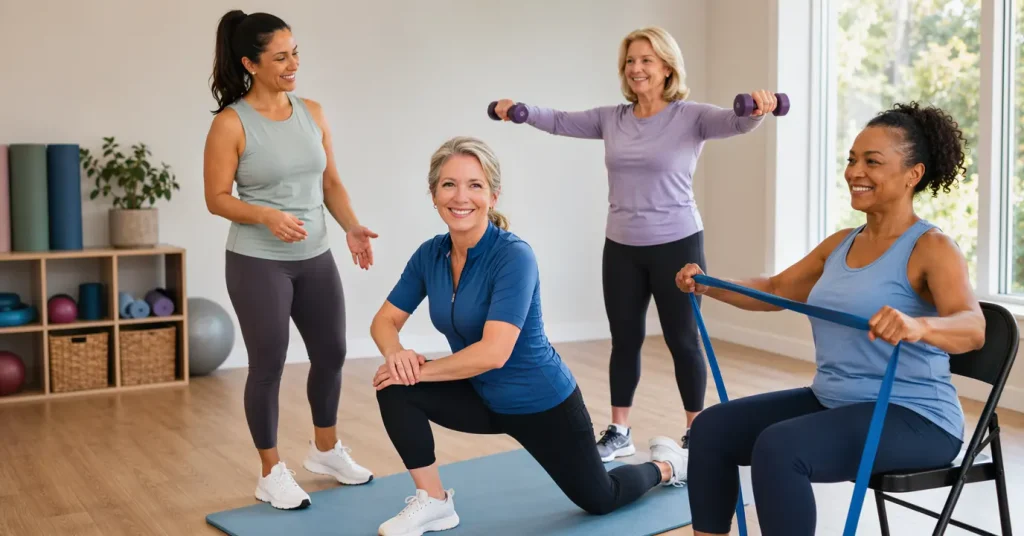
- Active women over 50 who already walk, stretch, or exercise regularly and want to add daily joint nutritional support
- Women who have restarted a fitness routine after a period of low activity
- Anyone who has already checked the ingredient list and confirmed it doesn’t interact with their current medications or health conditions
Please Talk to Your Doctor First If You
- Take blood thinners, diabetes medications, or blood pressure prescriptions
- Have a shellfish allergy (glucosamine is frequently shellfish-derived; verify the specific Flexi Move formula)
- Have a chronic kidney, liver, or autoimmune condition
- Are scheduled for surgery within two weeks
- Are pregnant or breastfeeding
My Honest Bottom Line

I spent two years making this harder than it needed to be. The stiffness wasn’t inevitable. Much of it was driven by specific, correctable habits, and once I corrected them, I got measurable ground back.
Flexi Move Joint Capsules are one part of my current routine, not the foundation. Movement, strength work, hydration, and proper warm-ups are the foundation. The capsules are an addition I chose to explore after researching, verifying the ingredient list, and confirming they don’t conflict with my health profile.
If you’re curious whether Flexi Move Joint Capsules belong in your routine, start by reviewing the verified formula, current price, refund policy, and purchase terms for yourself.
Support your joints and enhance your recoveryTry Flexi Move Joint Capsules today for the daily care your body deserves. Make your decision based on what’s actually in the bottle, not on marketing promises.
Supplement Disclaimer: Flexi Move Joint Capsules are a dietary supplement. This product is not intended to diagnose, treat, cure, or prevent any disease. Individual results vary. The FDA or equivalent regulatory body has not evaluated these statements. Consult a qualified healthcare professional before starting any supplement, especially if you take medication, have a medical condition, are pregnant, breastfeeding, or planning surgery.
Joint care works best within a broader healthy lifestyle after 50.
Weather can also worsen symptoms, as explained in this guide to joint pain when it rains.